






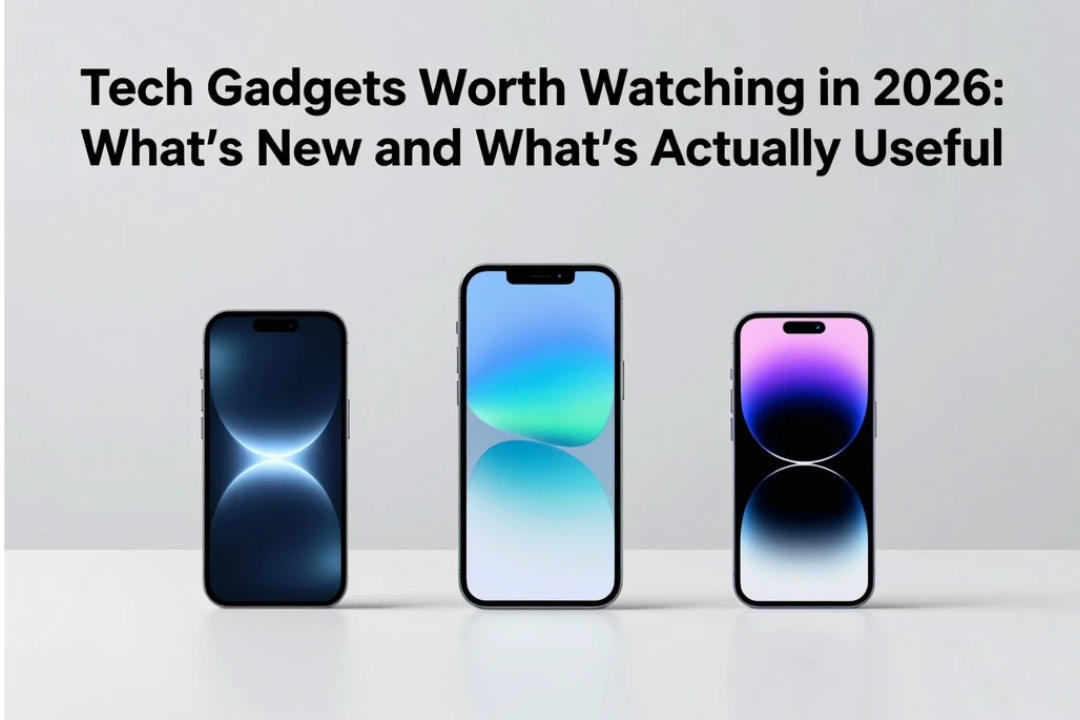
Technology continues to move quickly, and 2026 is shaping up to be another interesting year for gadgets. Artificial intelligence is becoming more deeply integrated into everyday devices, smartphones are becoming more flexible, laptops are getting smarter, and wearable technology is expanding beyond basic notifications and fitness tracking.
But there is an important difference between new technology and useful technology.
Not every futuristic gadget deserves your money. Some products introduce genuinely helpful features, while others are mainly designed to attract attention.
For consumers, the challenge is figuring out which tech gadgets in 2026 are worth watching and which ones are simply another short-lived trend.
From AI-powered devices and next-generation smartphones to smartwatches, laptops, earbuds, and smart-home products, here are the gadget categories that deserve attention this year.
1. AI-Powered Gadgets
Artificial intelligence is one of the biggest technology trends shaping gadgets in 2026.
Instead of AI existing mainly as a cloud-based chatbot or software feature, manufacturers are increasingly integrating AI directly into consumer devices.
AI can help gadgets understand commands, summarize information, organize content, improve images, translate conversations, automate tasks, and personalize the user experience.
AI-powered features are appearing across:
- Smartphones
- Laptops
- Smartwatches
- Earbuds
- Cameras
- Smart-home devices
- Cars
- Personal assistants
The most useful AI gadgets will be those that save time rather than simply adding an AI label to a product.
Why AI gadgets are worth watching
The real potential comes from automation.
Imagine a laptop that helps organize your files, a phone that summarizes conversations, or earbuds that provide real-time translation.
These features can make everyday technology more practical.
However, consumers should still evaluate whether the AI functions are genuinely useful before paying a premium.
2. AI PCs and Smarter Laptops
Laptops remain one of the most important gadget categories in 2026.
The biggest change is the growing focus on AI-capable PCs.
Modern laptops can use specialized hardware to handle certain AI tasks more efficiently. This can support features such as background noise reduction, webcam enhancements, productivity assistance, image processing, and other intelligent functions.
For everyday users, the most important benefits may be subtle.
Instead of manually adjusting settings, software can increasingly handle routine tasks automatically.
What to look for
When buying an AI-focused laptop, don’t look only for the words “AI PC.”
Consider:
- Processor performance
- RAM
- SSD storage
- Battery life
- Display quality
- Cooling
- AI processing capability
- Software compatibility
- Port selection
- Build quality
AI features are useful, but they should not replace the fundamentals.
3. Foldable Smartphones
Foldable smartphones continue to attract attention because they attempt to solve one of the biggest limitations of modern phones: screen size.
A traditional smartphone provides portability, but its display is relatively small.
Foldable designs can offer a larger screen while still allowing the device to become more compact when folded.
There are several approaches, including book-style foldables and flip-style devices.
Are foldables actually useful?
For some users, yes.
A larger internal display can be useful for:
- Multitasking
- Reading
- Watching videos
- Productivity
- Editing documents
- Browsing websites
However, buyers should also consider durability, thickness, weight, battery life, and price.
Foldables are becoming more practical, but they are still a category where consumers should carefully compare the benefits with the additional cost.
4. Smarter Smartwatches
Smartwatches have evolved far beyond simply showing notifications.
In 2026, wearable devices continue to focus on health, fitness, communication, navigation, and personalized insights.
Modern smartwatches can provide features such as:
- Heart-rate tracking
- Sleep monitoring
- Workout tracking
- GPS
- Activity tracking
- Notifications
- Calls
- Music controls
- Mobile payments
- Safety features
AI is also becoming more relevant to wearable technology.
Instead of simply collecting information, future devices can increasingly help users understand patterns in their activity and routines.
Who should consider one?
A smartwatch can be particularly useful for people who exercise regularly, want quick access to notifications, or prefer having basic information available without constantly reaching for their phone.
5. Smart Rings and Smaller Wearables
Smartwatches are not the only wearable gadgets gaining attention.
Smart rings offer a more discreet approach to wearable technology.
Because they are small and lightweight, they can focus on passive tracking and everyday convenience without putting a large screen on the user’s wrist.
Potential uses include:
- Sleep tracking
- Activity monitoring
- Health-related measurements
- Recovery insights
- Notifications through connected devices
The appeal of smart rings is simplicity.
Instead of another screen demanding attention, the device can quietly collect information in the background.
6. Advanced Wireless Earbuds
Wireless earbuds are becoming smarter as well.
Modern earbuds are no longer just miniature speakers. They can combine audio, microphones, noise cancellation, voice assistants, communication features, and AI-based functions.
Useful features include:
- Active noise cancellation
- Transparency modes
- Better microphones
- Multipoint connectivity
- Spatial audio
- Voice controls
- Improved battery life
- Real-time translation features
For frequent travelers and people who take calls throughout the day, these improvements can provide real practical value.
The most important factor, however, remains comfort and sound quality.
A long list of features does not matter if the earbuds hurt after 30 minutes.
7. Smart Home Gadgets
Smart-home technology continues to become more accessible.
Products such as smart lights, security cameras, smart plugs, thermostats, doorbells, and connected appliances can make everyday routines easier.
The most useful smart-home products are usually the ones that automate repetitive tasks.
For example, smart lighting can automatically turn on at a particular time, while security cameras can provide remote monitoring.
What makes a smart-home gadget useful?
Look for:
- Reliable connectivity
- Easy setup
- Good security
- App support
- Compatibility with your ecosystem
- Local controls where possible
- Long-term software support
Avoid buying a smart product simply because it can connect to the internet.
Ask whether connectivity actually makes the product more useful.
8. Portable Gaming Devices
Portable gaming hardware continues to attract consumers who want console-style gaming away from the living room.
Modern handheld gaming devices can provide significantly more performance than older portable systems.
Some focus on traditional console-style gaming, while others provide access to PC gaming libraries.
For gamers, the most important factors include:
- Performance
- Display
- Battery life
- Controls
- Weight
- Cooling
- Storage
- Game compatibility
A powerful handheld can be impressive, but battery life and comfort often determine whether you actually use it regularly.
9. Mini Projectors and Portable Displays
Portable projectors and compact displays are another gadget category worth watching.
Modern mini projectors can turn bedrooms, offices, outdoor areas, or temporary spaces into entertainment environments.
They can be useful for:
- Movies
- Presentations
- Gaming
- Education
- Travel
However, buyers should pay attention to brightness, resolution, speaker quality, connectivity, and portability.
A projector that looks impressive in a dark room may perform very differently in a bright environment.
10. Smarter Personal Health Gadgets
Consumer health technology continues to grow.
Wearables and connected devices can help people monitor aspects of their daily routines and fitness.
Examples include:
- Fitness trackers
- Smart scales
- Sleep trackers
- Blood-pressure monitoring devices
- Connected exercise equipment
These gadgets can make personal health data easier to access.
However, consumers should understand that consumer devices are not automatically substitutes for professional medical equipment or medical advice.
For health-related products, accuracy, validation, privacy, and manufacturer reputation matter more than flashy marketing.
11. Next-Generation Smartphone Accessories
Not every interesting gadget needs to be a completely new device.
Accessories are becoming increasingly sophisticated.
Examples include:
- Magnetic charging systems
- Portable power banks
- Smartphone cooling accessories
- Advanced camera accessories
- Wireless microphones
- Multi-device charging stations
- Portable storage
Some accessories can significantly improve an existing smartphone without requiring you to purchase a new phone.
For budget-conscious consumers, this can be one of the smartest ways to upgrade a technology setup.
12. Portable Power Stations
Portable power stations are becoming increasingly useful for homes, travel, outdoor activities, and backup power.
These devices can store electrical energy and provide power for selected electronics when conventional electricity is unavailable.
Depending on capacity, they can support devices such as:
- Smartphones
- Laptops
- Routers
- Lights
- Small appliances
When shopping for one, consider battery capacity, output power, charging speed, portability, safety features, and available ports.
Choose capacity according to your actual requirements rather than simply buying the largest model.
13. AR and Spatial Computing Devices
Augmented reality and spatial computing remain interesting areas of development.
These technologies attempt to combine digital information with the physical environment or create immersive virtual spaces.
Potential applications include:
- Productivity
- Education
- Gaming
- Design
- Entertainment
- Training
- Virtual meetings
The technology is exciting, but the biggest question remains everyday usefulness.
A product can be technically impressive without becoming a mainstream consumer gadget.
For now, this is a category worth watching rather than automatically buying.
14. Smart Cameras and AI Photography
Cameras are becoming smarter through computational photography and AI-based processing.
Modern camera systems can automatically improve exposure, reduce noise, recognize scenes, enhance portraits, and assist with editing.
This trend is especially important in smartphones.
The result is that users can capture better-looking images without understanding advanced photography settings.
For casual photographers, AI-assisted cameras can provide significant practical benefits.
15. Eco-Friendly and Repairable Gadgets
Sustainability is becoming more important in consumer technology.
Buyers are increasingly interested in products that last longer, consume less energy, use recycled materials, or are easier to repair.
Repairable designs can also reduce electronic waste.
When choosing a gadget, consider:
- Product lifespan
- Software support
- Replaceable components
- Battery replacement options
- Repair availability
- Energy efficiency
- Manufacturer support
A gadget that lasts several years can provide better value than a cheaper device that needs to be replaced quickly.
Which 2026 Gadgets Are Actually Worth Watching?
Not every emerging gadget deserves equal attention.
Here is a simple comparison:
| Gadget Category | Potential Usefulness | Best For |
|---|---|---|
| AI Smartphones | High | Everyday users |
| AI Laptops | High | Students and professionals |
| Smartwatches | High | Fitness and productivity |
| Wireless Earbuds | High | Calls, music and travel |
| Smart Home Devices | High | Home automation |
| Foldable Phones | Medium-High | Multitasking and portability |
| Smart Rings | Medium | Passive tracking |
| Portable Gaming | High | Gamers |
| Portable Projectors | Medium | Entertainment |
| AR/Spatial Devices | Emerging | Early adopters |
| Portable Power Stations | High | Backup and outdoor use |
| Repairable Gadgets | High | Long-term buyers |
The most useful categories are generally those that solve everyday problems.
How to Decide Whether a New Gadget Is Worth Buying
Before spending money on a new technology product, ask five simple questions.
1. Does it solve a real problem?
If you cannot identify a practical benefit, you probably don’t need it.
2. Will I use it regularly?
A gadget that sits in a drawer is rarely a good investment.
3. Does it work with my existing devices?
Compatibility can make or break the experience.
4. Is the technology mature enough?
First-generation products can sometimes have higher prices, fewer accessories, or unresolved issues.
5. Does the price match the benefit?
A useful gadget does not necessarily have to be expensive.
What Gadgets Should You Avoid?
Be cautious with products that:
- Make unrealistic promises
- Have very little independent information
- Depend on an unclear subscription
- Have poor software support
- Come from unknown sellers
- Lack warranty coverage
- Have privacy concerns
- Offer features you will never use
A gadget should provide meaningful value rather than simply looking futuristic.
Final Thoughts
The tech gadgets of 2026 are becoming smarter, more connected, and increasingly influenced by artificial intelligence.
AI-powered smartphones, smarter laptops, advanced wearables, wireless earbuds, foldable phones, smart-home products, portable gaming devices, and power solutions all offer interesting possibilities.
But the most exciting gadget is not necessarily the best gadget for everyone.
Before buying, focus on usefulness.
Ask what problem the device solves, how often you will use it, whether it works with your existing technology, how long it will remain supported, and whether the price makes sense.
The best technology is ultimately technology that makes everyday life easier.
In 2026, consumers have more choices than ever. That makes smart buying decisions even more important.
Frequently Asked Questions
What are the best tech gadgets to watch in 2026?
AI-powered smartphones and laptops, smartwatches, wireless earbuds, foldable phones, smart-home devices, portable gaming systems, smart rings, and portable power stations are among the most interesting categories to watch.
Are AI gadgets worth buying in 2026?
They can be, especially when AI provides useful features such as automation, image enhancement, translation, productivity assistance, or personalized recommendations. However, buyers should not pay extra simply because a product has an AI label.
Are foldable smartphones worth it?
Foldable smartphones can be useful for multitasking, entertainment, and productivity. However, buyers should consider price, durability, weight, battery life, and repair costs before purchasing.
Are smartwatches still useful?
Yes. Modern smartwatches can combine fitness tracking, health-related measurements, notifications, GPS, communication, payments, and other features in a convenient wearable device.
What should I consider before buying a new gadget?
Consider your needs, budget, compatibility, performance, battery life, software support, warranty, durability, privacy, and long-term value.
Should I buy a new gadget immediately after launch?
Not necessarily. Waiting for independent reviews can help you identify performance problems, battery issues, software bugs, and other limitations.
What is the most important trend in gadgets in 2026?
Artificial intelligence is one of the most important trends because it is being integrated into smartphones, laptops, wearables, audio devices, cameras, and smart-home products.
Final Verdict
2026 is an exciting year for technology, but smart consumers should look beyond the hype.
AI, smarter wearables, foldable devices, connected homes, portable gaming, and advanced accessories all have real potential.
The winning strategy is simple: don’t buy the gadget that looks the most futuristic. Buy the gadget that provides the most useful solution for your lifestyle, budget, and everyday needs.