

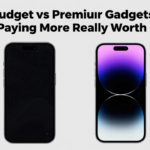

Buying a new gadget often comes down to one major question: Should you save money with a budget device or spend more on a premium model?
The answer is not always straightforward.
A premium smartphone may offer a better camera, brighter display, faster processor, stronger materials, and longer software support. But a budget phone may already provide everything an average user needs.
The same is true for laptops, smartwatches, headphones, tablets, cameras, and other technology products.
In some cases, paying more delivers a noticeably better experience. In others, you may be spending hundreds of dollars for features you will rarely use.
Understanding the difference between budget vs premium gadgets can help you make smarter purchasing decisions and get better value from your money.
What Is a Budget Gadget?
Budget gadgets are designed to provide essential features at a lower price.
They typically focus on practical everyday performance rather than premium materials or advanced features.
A budget smartphone, for example, may provide:
- Good battery life
- A capable display
- Decent cameras
- Everyday performance
- Basic connectivity
- Essential software features
Budget products are particularly attractive to students, casual users, families, and people who simply don’t need flagship-level performance.
The important thing to remember is that budget does not automatically mean bad.
Technology has become increasingly competitive, and affordable devices can now offer impressive capabilities.
What Is a Premium Gadget?
Premium gadgets generally sit at the higher end of a manufacturer’s product range.
They often provide improvements in areas such as:
- Build quality
- Performance
- Display technology
- Camera systems
- Battery management
- Materials
- Software features
- Connectivity
- Long-term support
Premium devices can be especially useful for professionals, enthusiasts, creators, gamers, and users who depend heavily on their technology.
However, premium pricing does not mean every feature provides equal value.
Budget vs Premium: The Biggest Differences
The difference between budget and premium products is usually not one single feature.
Instead, premium devices often provide improvements across multiple areas.
| Feature | Budget Gadgets | Premium Gadgets |
|---|---|---|
| Price | Lower | Higher |
| Performance | Good for everyday use | Higher-end |
| Build | Practical | Premium materials |
| Display | Good | More advanced |
| Cameras | Basic to capable | More versatile |
| Battery | Often strong | Strong with advanced management |
| Software | Essential features | More advanced features |
| Updates | Varies | Often stronger support |
| Design | Functional | More refined |
| Accessories | Basic | More extensive ecosystem |
| Best For | Casual users | Enthusiasts and professionals |
The right choice depends on which of these differences actually matter to you.
1. Performance: Does Paying More Make a Difference?
Performance is one of the most noticeable differences between budget and premium gadgets.
Premium smartphones and laptops generally use more powerful hardware.
This can matter if you:
- Edit videos
- Play demanding games
- Run professional applications
- Multitask heavily
- Work with large files
- Use demanding creative software
For basic browsing, email, social media, streaming, and document work, a budget or mid-range device may be more than enough.
The key question
Don’t ask:
“Which device is faster?”
Ask:
“Do I need that extra performance?”
If you don’t, paying more may not provide a meaningful benefit.
2. Build Quality and Design
Premium gadgets often feel different in your hands.
Manufacturers may use materials such as metal, glass, high-quality plastics, or other premium finishes.
You may also get:
- Better buttons
- Stronger hinges
- More refined designs
- Improved water resistance
- Better ergonomics
Budget gadgets typically focus on practicality and keeping production costs under control.
If you use a gadget for several years, better build quality can be worth considering.
However, a protective case can also help extend the life of an affordable device.
3. Display Quality
Displays are another area where premium gadgets can have a clear advantage.
Premium models may offer:
- Higher brightness
- Better contrast
- Higher refresh rates
- More accurate colors
- Better HDR performance
- Higher resolution
- Improved outdoor visibility
These differences matter particularly to photographers, video editors, gamers, and people who spend many hours looking at screens.
For basic messaging, browsing, and office work, a good budget display may be perfectly acceptable.
4. Camera Quality
Smartphone cameras are a good example of where premium pricing can make a significant difference.
Premium smartphones often provide more advanced camera systems with improved:
- Low-light performance
- Optical zoom
- Stabilization
- Video recording
- Image processing
- Portrait photography
- Computational photography
Budget phones can still capture good everyday photos, especially in favorable lighting.
If photography is one of your biggest priorities, paying more may make sense.
If you mainly take casual photos for messaging and social media, a budget or mid-range phone may be sufficient.
5. Battery Life
Interestingly, budget gadgets can sometimes perform surprisingly well in battery life.
Because manufacturers may prioritize larger batteries and less demanding hardware, some affordable devices can provide excellent endurance.
Premium products may have more powerful processors and brighter displays, but they can also use advanced power-management technologies.
The important thing is to look at real-world battery performance, not just battery capacity.
6. Software and Updates
Software support can be one of the most important reasons to consider a premium gadget.
Longer software support can provide:
- Security improvements
- New features
- Bug fixes
- Better compatibility
- Longer useful life
If you plan to keep your smartphone, tablet, smartwatch, or laptop for several years, software support should be part of your buying decision.
A slightly more expensive device that remains supported for longer may provide better value over time.
7. Premium Features You May Actually Use
Premium gadgets often include advanced features that aren’t available on cheaper models.
Examples can include:
- Advanced camera systems
- Wireless charging
- Better speakers
- Faster connectivity
- Biometric security
- Advanced health sensors
- Higher-quality displays
- More powerful processors
- Specialized AI features
The question is whether those features improve your daily life.
If you use them regularly, paying more can be justified.
If you never use them, they become expensive extras.
8. Budget Gadgets Can Be the Smarter Choice
There is a common misconception that buying premium technology is always the smarter decision.
That’s not true.
For many users, budget gadgets provide better value.
Consider a student who needs a laptop for:
- Web browsing
- Research
- Word processing
- Video classes
- Presentations
Buying a high-end laptop may provide performance the student never uses.
A well-chosen affordable laptop could accomplish the same tasks for considerably less money.
The money saved could be used for accessories, education, savings, or other priorities.
9. Premium Gadgets Can Be Worth It for Heavy Users
Premium technology becomes easier to justify when the device plays an important role in your work or hobbies.
For example, a professional video editor may benefit from:
- Faster processing
- More RAM
- Better displays
- Larger storage
- Better connectivity
Similarly, a serious gamer may benefit from higher performance and better displays.
A professional photographer may value advanced camera hardware.
For these users, the extra cost can directly improve productivity or enjoyment.
10. Think About Cost Per Year
One useful way to compare budget and premium gadgets is to consider how long you expect to use them.
Imagine:
- Budget gadget: $300 and used for 2 years
- Premium gadget: $900 and used for 5 years
The premium device costs more initially, but the annual cost difference may be smaller than expected.
Of course, this depends on durability, software support, battery health, repair costs, and actual usage.
The cheapest product isn’t always the cheapest over its entire lifespan.
11. Don’t Ignore the Mid-Range
The biggest mistake in the budget vs premium debate is assuming you only have two choices.
There is a large middle category.
Mid-range gadgets often provide an excellent balance between:
- Price
- Performance
- Features
- Battery life
- Build quality
- Cameras
- Software
For many buyers, the mid-range segment offers the best overall value.
You may not get every premium feature, but you can often get the features that matter most without paying for everything else.
12. Where Premium Is Usually Worth Considering
Paying more can make sense when the upgrade directly affects something important to you.
Premium smartphones
Worth considering if you prioritize cameras, performance, displays, gaming, or long-term software support.
Premium laptops
Worth considering for professional workloads, gaming, content creation, software development, or heavy multitasking.
Premium headphones
Worth considering if you care strongly about sound quality, noise cancellation, microphone quality, and comfort.
Premium smartwatches
Worth considering for advanced fitness, health-related features, navigation, communication, and ecosystem integration.
Premium cameras
Worth considering for professional or serious photography and video production.
13. Where Budget Gadgets Are Often Enough
Affordable gadgets can be ideal for:
- Basic smartphones
- Simple tablets
- Everyday headphones
- Fitness trackers
- Secondary devices
- Children’s devices
- Basic smart-home products
- Casual gaming
- Simple office work
The important thing is to identify your actual requirements.
14. Watch Out for the “Premium Tax”
Sometimes you’re paying extra for branding rather than a major improvement.
A premium product can carry a higher price because of:
- Brand reputation
- Design
- Materials
- Marketing
- Ecosystem
- Exclusivity
These things can have value, but you should know what you’re paying for.
If two products provide nearly identical real-world performance for your needs, the cheaper option may be the smarter purchase.
15. Consider the Ecosystem
Sometimes premium gadgets become more valuable when combined with other products from the same ecosystem.
For example, a smartphone may work particularly well with a company’s smartwatch, laptop, earbuds, cloud services, and other accessories.
This convenience can be worth paying for.
But ecosystem lock-in can also make future switching more difficult.
Before investing heavily in one ecosystem, consider whether you are comfortable staying with it for several years.
How to Decide Between Budget and Premium
Use this simple decision process.
Step 1: Define your main use
Write down exactly what you will do with the gadget.
Step 2: Identify your must-have features
Ignore features that don’t matter to you.
Step 3: Set a realistic budget
Choose a price range before you start shopping.
Step 4: Compare three options
Look at:
- Budget
- Mid-range
- Premium
Step 5: Identify the real upgrade
Ask what you actually get by spending more.
Step 6: Calculate long-term value
Consider software support, durability, battery, warranty, repair costs, and expected lifespan.
Step 7: Buy based on value
Choose the product that best matches your needs—not necessarily the most expensive one.
Budget vs Premium: Who Should Buy What?
| User Type | Recommended Choice | Why |
|---|---|---|
| Student | Budget/Mid-range | Good value |
| Casual User | Budget | Enough for everyday tasks |
| Business User | Mid-range/Premium | Reliability and productivity |
| Gamer | Mid-range/Premium | Performance matters |
| Content Creator | Premium | Advanced performance |
| Photographer | Mid-range/Premium | Camera quality matters |
| Frequent Traveler | Mid-range/Premium | Battery and durability |
| Child/Secondary User | Budget | Lower replacement cost |
| Technology Enthusiast | Premium | Advanced features |
Common Mistakes When Choosing Between Budget and Premium
Avoid these mistakes:
Buying premium just for status
A premium logo doesn’t automatically mean better value.
Buying the cheapest option
The lowest price may come with compromises in durability, software, or performance.
Ignoring your usage
Your workload should determine the specifications.
Forgetting long-term costs
Consider accessories, subscriptions, repairs, and replacement batteries.
Following influencers blindly
A gadget that is perfect for an enthusiast may be unnecessary for an average user.
Final Thoughts
The debate between budget vs premium gadgets does not have one universal answer.
Budget gadgets can offer outstanding value for everyday users, students, families, and anyone who doesn’t need advanced performance.
Premium gadgets can be worth the extra money when you genuinely benefit from better performance, cameras, displays, build quality, software support, connectivity, or specialized features.
For many people, however, the sweet spot is somewhere in the middle.
A good mid-range product can provide most of the experience people actually need without the premium price.
The smartest approach is simple:
Don’t ask whether an expensive gadget is better. Ask whether it is better for you.
If the premium features save you time, improve your work, enhance your hobbies, or make the device significantly more enjoyable, paying more can be justified.
If you won’t use those features, keep your money and choose the product that delivers the essentials at a sensible price.
Frequently Asked Questions
Are premium gadgets really better than budget gadgets?
Premium gadgets usually offer better performance, materials, displays, cameras, or software support, but that does not mean they are better for every user.
Is it better to buy a budget or premium smartphone?
It depends on your needs. Casual users can often get excellent value from budget or mid-range phones, while photographers, gamers, and power users may benefit from premium models.
Are expensive gadgets worth the money?
They can be worth it when the additional features provide meaningful benefits. If you rarely use those features, a cheaper product may provide better value.
Is mid-range technology better value?
Often, yes. Mid-range gadgets can provide a strong balance between price, performance, features, and quality.
Should I buy the cheapest gadget available?
Not necessarily. Extremely cheap products may compromise durability, software support, performance, or warranty coverage.
How can I tell if a premium gadget is worth buying?
Compare the premium model with a cheaper alternative and identify exactly what you gain by spending more. If those improvements matter to your daily use, the premium model may be worth it.
Does a premium gadget last longer?
It can, particularly when it has better build quality, stronger hardware, and longer software support. However, durability varies by product and manufacturer.
What is the best strategy for saving money on gadgets?
Focus on features you actually need, compare several products, consider previous-generation models, and don’t pay extra for features you are unlikely to use.
Final Verdict
Budget gadgets are about getting the essentials. Premium gadgets are about getting more.
The best choice depends on how much those extra features matter to you.
For casual users, budget and mid-range devices can provide excellent value. For professionals, enthusiasts, creators, and demanding users, premium technology can be a worthwhile investment.
Before spending your money, compare the price, performance, features, durability, software support, warranty, and expected lifespan.
The smartest purchase is not the cheapest gadget or the most expensive gadget.
It is the gadget that gives you the best value for the way you actually use technology.