








When you read a technology review, you may see numbers for performance, battery life, display brightness, camera quality, charging speed, or other features.
But how do reviewers actually get those results?
Testing a gadget is much more complicated than simply using it for a few hours and deciding whether it feels good.
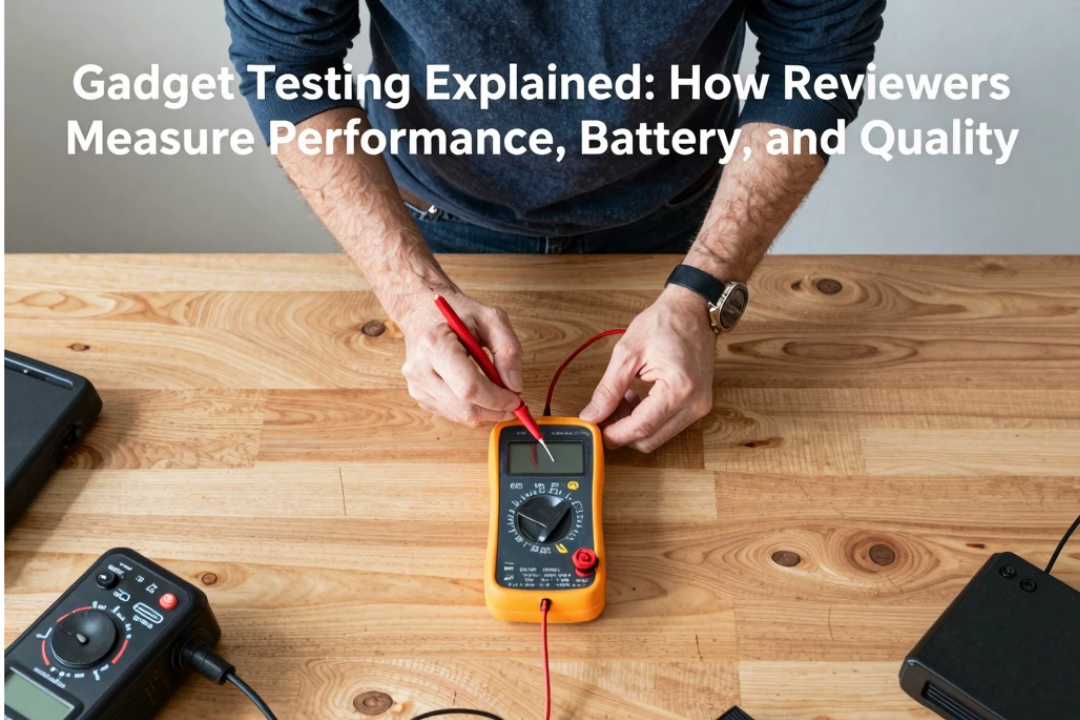
Professional reviewers use a combination of benchmarks, controlled tests, everyday usage, comparisons, measurements, and long-term observations to understand how a product performs.
This process helps separate marketing claims from real-world performance.
Whether the product is a smartphone, laptop, smartwatch, tablet, headphones, camera, or another electronic device, a good review should test the things that actually matter to buyers.
In this guide, we’ll explain how gadget testing works and what reviewers typically measure before reaching a final verdict.
What Is Gadget Testing?
Gadget testing is the process of evaluating a technology product across different categories to determine its performance, quality, reliability, usability, and value.
A reviewer may test:
- Performance
- Battery life
- Charging speed
- Display
- Camera
- Audio
- Software
- Connectivity
- Build quality
- Comfort
- Durability
- Features
- Heat management
- Long-term reliability
The goal is not simply to collect numbers.
The goal is to understand how the gadget performs in real situations.
A benchmark might tell you that one device is faster than another, but real-world testing determines whether you can actually notice the difference.
1. Performance Testing
Performance is one of the first areas reviewers evaluate.
For smartphones and laptops, this can include processor performance, graphics performance, memory management, storage speed, and multitasking.
Reviewers may use standardized benchmarking tools to generate repeatable results.
These tests can measure things such as:
- CPU performance
- GPU performance
- Memory performance
- Storage speed
- Application loading
- Rendering
- Gaming performance
Benchmark results are useful for comparisons, but they should not be the only measurement.
Why Benchmarks Aren’t Everything
A device may achieve an impressive benchmark score but still have poor thermal management or inefficient software.
For this reason, reviewers often combine benchmark results with real-world testing.
For example, they might:
- Open multiple applications
- Edit photos
- Export videos
- Play demanding games
- Browse with many tabs
- Transfer large files
- Run applications simultaneously
This provides a better understanding of how the gadget behaves during normal workloads.
2. Real-World Performance Testing
Real-world testing is one of the most important parts of a good gadget review.
Instead of relying only on synthetic benchmarks, reviewers use the product like an ordinary customer.
A smartphone might be used for:
- Social media
- Photography
- Video streaming
- Navigation
- Gaming
- Messaging
- Calls
- Web browsing
A laptop might be used for:
- Documents
- Browsing
- Video calls
- Programming
- Photo editing
- Video editing
- Multitasking
This helps determine whether the product is actually enjoyable and practical to use.
3. Battery Life Testing
Battery life can be difficult to measure because everyone’s usage is different.
A person who plays games for several hours will get different results from someone who mainly sends messages.
Professional reviewers therefore use both controlled and real-world battery tests.
Controlled testing
A reviewer may use a consistent brightness level, network connection, application workload, and other settings.
This makes it easier to compare products fairly.
Real-world testing
The device is then used normally throughout the day.
Reviewers may record:
- Screen-on time
- Standby time
- Gaming time
- Video playback
- Web browsing
- Camera usage
- Calls
- Charging frequency
The combination of both methods gives a more realistic picture.
4. Charging Speed Testing
Battery capacity isn’t the only thing that matters.
Charging speed can have a major impact on convenience.
Reviewers may measure how quickly a device charges from:
- 0% to 25%
- 0% to 50%
- 0% to 80%
- 0% to 100%
They may also monitor how charging speed changes as the battery becomes fuller.
Many devices charge quickly at lower battery percentages and slow down as they approach full capacity.
Reviewers may also check whether the advertised charging speed is achieved under appropriate conditions.
5. Display Testing
Displays are tested using both technical measurements and visual evaluation.
Reviewers may examine:
- Brightness
- Contrast
- Color accuracy
- Resolution
- Refresh rate
- Viewing angles
- Outdoor visibility
- HDR performance
- Touch responsiveness
Brightness is particularly important for mobile devices.
A display that looks excellent indoors may be difficult to see outside under strong sunlight.
Refresh rate testing
A higher refresh rate can make scrolling and animations appear smoother.
However, reviewers also check whether the device can maintain that refresh rate consistently and whether using it affects battery life.
6. Camera Testing
Camera testing is much more complicated than looking at megapixels.
Reviewers typically capture photos in different environments.
These may include:
- Bright daylight
- Indoor lighting
- Low light
- Night scenes
- Portraits
- Moving subjects
- Close-ups
- Landscapes
- Zoom shots
They may evaluate:
- Detail
- Color
- Dynamic range
- Noise
- Autofocus
- Stabilization
- Skin tones
- HDR processing
Video recording is also tested.
Reviewers may examine stabilization, audio quality, exposure, autofocus, resolution, and frame-rate options.
Why Camera Comparisons Matter
A camera may look excellent on its own but perform differently when compared with competing products.
Side-by-side comparisons can reveal differences that are difficult to notice from specifications alone.
7. Audio Testing
For smartphones, laptops, tablets, headphones, speakers, and earbuds, audio quality is another important category.
Reviewers may evaluate:
- Bass
- Midrange
- Treble
- Volume
- Clarity
- Distortion
- Soundstage
- Microphone quality
For headphones and earbuds, comfort is equally important.
A product can sound excellent but still be disappointing if it becomes uncomfortable after extended use.
8. Build Quality Testing
Build quality is usually evaluated through careful inspection and everyday handling.
Reviewers look at:
- Materials
- Buttons
- Hinges
- Ports
- Seams
- Screen protection
- Weight
- Flex
- Finish
They may also check whether components feel loose or poorly assembled.
Professional reviewers generally avoid unnecessary destructive testing unless a product is specifically designed for that type of evaluation.
The goal is to determine whether the device feels appropriately durable for its price.
9. Thermal and Heat Testing
Performance can change when a gadget gets hot.
This is particularly important for:
- Gaming smartphones
- Gaming laptops
- High-performance laptops
- Tablets
- Portable gaming devices
Reviewers may run demanding workloads for extended periods and observe:
- Surface temperature
- Performance changes
- Fan noise
- Throttling
- Battery consumption
A device that performs extremely well for five minutes but slows down significantly under sustained workloads may not be ideal for demanding users.
10. Software Testing
Hardware is only part of the user experience.
Reviewers also evaluate the software.
They may look at:
- User interface
- App performance
- Bugs
- Settings
- Customization
- Multitasking
- Security features
- Updates
- Pre-installed applications
They may also check whether the software feels polished and intuitive.
Two devices with similar hardware can provide very different experiences because of software optimization.
11. Connectivity Testing
Modern gadgets depend heavily on connectivity.
Depending on the product, reviewers may test:
- Wi-Fi
- Bluetooth
- Cellular connectivity
- GPS
- NFC
- USB
- HDMI
- Audio connections
- Wireless accessories
The exact tests depend on the device.
For laptops, port selection can be particularly important.
For smartphones, wireless performance and Bluetooth reliability may matter more.
12. Storage Testing
Storage performance can affect how quickly a device starts applications, transfers files, or loads games.
Reviewers may test:
- Sequential read speeds
- Sequential write speeds
- File transfers
- Application loading
- Large file copying
But storage capacity is just as important.
A fast drive with insufficient capacity can become frustrating for users who store large files.
13. Comfort and Ergonomics
Some of the most important aspects of a gadget cannot be measured with a benchmark.
Comfort is one of them.
Reviewers consider:
- Weight
- Size
- Grip
- Keyboard comfort
- Trackpad
- Button placement
- Screen positioning
- Wearability
For smartwatches and headphones, comfort can be one of the biggest deciding factors.
A technically excellent gadget isn’t very useful if you don’t enjoy wearing or using it.
14. Durability and Long-Term Testing
Short-term reviews cannot reveal every potential problem.
That’s why some reviewers continue testing devices for weeks or months.
Long-term testing can reveal:
- Battery degradation
- Scratches
- Software problems
- Loose components
- Heating issues
- Performance changes
- Wear and tear
Long-term reviews are particularly valuable for expensive gadgets.
15. Testing Special Features
If a manufacturer promotes a particular feature, reviewers should test it.
For example, if a device advertises:
- AI functions
- Advanced noise cancellation
- Professional camera features
- Health tracking
- Water resistance
- Gaming modes
- Fast charging
Those features should be tested under realistic conditions.
A feature shouldn’t receive high praise simply because it exists on the specification sheet.
The important question is:
Does it actually work well?
16. Comparing the Gadget With Competitors
A product doesn’t exist in isolation.
A $1,000 gadget should be compared with other products in a similar price range.
Reviewers may compare:
| Category | Product A | Product B |
|---|---|---|
| Performance | High | Medium |
| Battery | Excellent | Good |
| Display | Excellent | Good |
| Camera | Excellent | Good |
| Build | Premium | Good |
| Software | Strong | Strong |
| Price | Higher | Lower |
| Value |
This helps readers understand whether the product is actually competitive.
17. Value-for-Money Testing
A gadget review should not only ask:
“Is this a good product?”
It should also ask:
“Is this a good product for the price?”
A $300 gadget doesn’t need to outperform a $1,000 flagship to be considered excellent.
If it delivers 90% of what most users need at a fraction of the price, it may provide better value.
Price is therefore an important part of the final review.
18. Creating a Gadget Review Score
Some reviewers use scoring systems to make comparisons easier.
A possible scoring system could look like this:
| Category | Weight |
|---|---|
| Performance | 20% |
| Design & Build | 15% |
| Battery | 15% |
| Display/Audio/Camera | 15% |
| Software | 10% |
| Features | 10% |
| Comfort & Usability | 5% |
| Value | 10% |
The exact percentages can change depending on the type of product.
For a camera, image quality might receive more weight.
For a laptop, performance and keyboard quality might matter more.
For earbuds, audio quality and comfort may dominate the score.
Why Consistent Testing Matters
The biggest advantage of a structured testing process is consistency.
If every product is tested differently, comparisons become difficult.
Reviewers should try to keep important conditions consistent.
For example:
- Similar brightness
- Similar workloads
- Similar testing duration
- Same measurement equipment
- Similar network conditions
This doesn’t eliminate every variable, but it makes results more useful.
What Readers Should Look for in a Good Gadget Review
A trustworthy review should explain:
- How the product was tested
- Which features were evaluated
- Real-world performance
- Battery results
- Important limitations
- Comparison with alternatives
- Value for money
- Who should buy it
- Who should avoid it
Be cautious of reviews that only repeat manufacturer specifications.
A useful review should provide information you cannot easily get from a product page.
Common Gadget Testing Mistakes
Even reviewers can make testing mistakes.
Testing for too little time
Short testing periods may hide problems.
Relying entirely on benchmarks
Synthetic scores don’t always represent real-world use.
Ignoring software
Hardware specifications don’t tell the complete story.
Testing only ideal conditions
A gadget should be tested in realistic environments.
Ignoring price
A product’s value depends partly on what competitors offer at the same price.
Focusing only on specifications
Numbers are useful, but user experience matters too.
How Manufacturers Test Gadgets
Professional manufacturers generally use much more extensive testing than consumer reviewers.
Depending on the product, companies may perform:
- Temperature testing
- Drop testing
- Vibration testing
- Battery testing
- Water and dust testing
- Screen testing
- Component testing
- Software testing
- Connectivity testing
- Manufacturing quality checks
These tests help manufacturers identify problems before products reach customers.
However, independent reviews remain valuable because reviewers evaluate the product from a consumer perspective.
Final Thoughts
Gadget testing is about much more than running a benchmark and checking a specification sheet.
A good reviewer looks at the complete experience.
Performance, battery life, display quality, cameras, audio, software, connectivity, comfort, build quality, durability, and value all contribute to whether a gadget is worth buying.
The best reviews combine technical measurements with real-world usage.
That’s important because specifications tell you what a product is supposed to do, while testing helps show what the product actually does.
For consumers, this distinction can save money and prevent disappointing purchases.
Before buying your next smartphone, laptop, smartwatch, headphones, or other gadget, don’t just look at the headline specifications.
Look for evidence of how the product performs in everyday conditions.
Frequently Asked Questions
How do reviewers test gadgets?
Reviewers typically combine benchmarks, controlled measurements, real-world usage, comparisons, and long-term testing to evaluate a gadget.
How is battery life tested?
Battery life can be tested through controlled workloads and normal daily use. Reviewers may measure screen-on time, video playback, gaming, browsing, standby time, and charging speed.
Are benchmark scores reliable?
Benchmarks can be useful for comparing performance under controlled conditions, but they should not be the only factor. Real-world performance is equally important.
How do reviewers test smartphone cameras?
They usually capture photos and videos in different lighting conditions and evaluate detail, colors, dynamic range, autofocus, stabilization, low-light performance, zoom, and video quality.
Why is thermal testing important?
Heat can affect performance, comfort, battery consumption, and long-term reliability. Thermal testing helps reveal whether a device can maintain performance during sustained workloads.
How long should a gadget be tested?
There is no single correct testing period. Basic performance can be evaluated quickly, while durability, battery behavior, and long-term software reliability require much longer testing.
What makes a gadget review trustworthy?
A trustworthy review explains the testing process, discusses both strengths and weaknesses, provides real-world observations, compares alternatives, and considers value for money.
Should I trust manufacturer specifications?
Manufacturer specifications are useful for understanding a product’s capabilities, but independent testing can provide additional information about real-world performance.
Final Verdict
The best gadget reviews are not simply lists of specifications.
They are evidence-based evaluations of how a product performs in real life.
Performance benchmarks, battery tests, display measurements, camera comparisons, thermal testing, software evaluation, comfort checks, and long-term usage all contribute to a complete picture.
As a buyer, understanding the testing process can also help you read reviews more intelligently.
Don’t focus on one impressive number.
Look at the complete testing picture—and then decide whether the gadget is actually worth your money.