







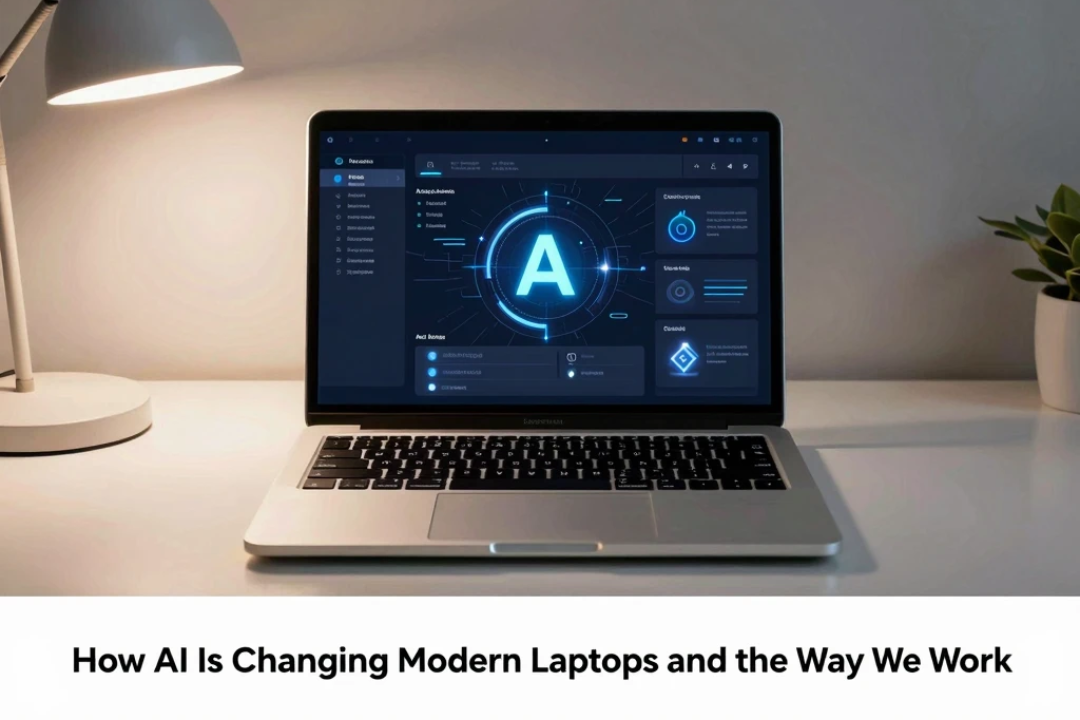
Laptops have always been important tools for work, education, communication, and entertainment. But modern laptops are becoming much more than traditional portable computers.
Artificial intelligence is changing how laptops process information, manage resources, communicate with users, and perform everyday tasks. From AI-powered video calls and writing assistants to smarter battery management and on-device processing, artificial intelligence is becoming an increasingly important part of the modern laptop experience.
In 2026, laptop manufacturers are not only competing on processor speed, RAM, storage, and display quality. They are also focusing on dedicated AI hardware and software features designed to make computers more intelligent and useful.
This shift is changing not only the technology inside laptops but also the way people work with computers.
What Does AI Mean in a Modern Laptop?
AI in a laptop refers to hardware and software that can perform tasks involving pattern recognition, language processing, image analysis, automation, and other forms of intelligent computing.
Modern laptops may include specialized hardware designed to handle AI workloads efficiently. This can work alongside the CPU and GPU to process certain AI tasks.
AI features can be used for:
- Writing and summarizing
- Video conferencing
- Image and video editing
- Voice recognition
- Noise reduction
- Search
- Security
- Battery management
- Productivity automation
The goal isn’t simply to make a laptop faster. It’s to make the computer more capable of understanding what the user is trying to accomplish.
1. AI Is Making Everyday Tasks Faster
One of the biggest benefits of AI is automation.
Many computer tasks that previously required several steps can now be completed with assistance from AI tools.
For example, AI can help users summarize long documents, rewrite text, organize information, generate ideas, and analyze content.
Instead of spending significant time performing repetitive tasks, users can use AI to handle parts of the process.
This can be particularly useful for professionals who regularly work with documents, emails, reports, spreadsheets, or presentations.
2. AI Assistants Are Becoming Part of the Laptop Experience
AI assistants are becoming more integrated into operating systems and applications.
Instead of using a computer only through menus and traditional commands, users can interact with AI using natural language.
A user might ask an AI assistant to:
- Summarize a document
- Explain a complicated topic
- Draft an email
- Create a list
- Rewrite text
- Find information
- Generate ideas
- Help troubleshoot a problem
This makes computers more accessible to people who aren’t highly technical.
The user doesn’t always need to know exactly which application or setting to open. They can simply describe what they want.
3. AI Is Improving Video Meetings
Remote work and online meetings have become an important part of modern professional life.
AI is improving the quality of these meetings through features such as background noise reduction, automatic framing, lighting adjustments, and voice enhancement.
AI-powered audio processing can help reduce unwanted sounds such as keyboard noise, fans, or background conversations.
Camera features can also help keep the user’s face centered or improve the appearance of the image under less-than-ideal lighting conditions.
These features can make online meetings feel more professional without requiring expensive equipment.
4. AI Can Improve Writing and Communication
Writing is another area where AI is changing laptop usage.
AI writing tools can help users create, rewrite, summarize, and refine text.
For example, someone may write a rough message and ask an AI tool to make it more professional.
Students can use AI to understand complex concepts, while professionals can use it to organize ideas or create initial drafts.
However, AI should be treated as an assistant rather than an automatic replacement for human judgment.
Users still need to review generated content for accuracy, tone, originality, and context.
5. AI Is Changing Photo and Video Editing
Content creators are also benefiting from AI-powered laptop software.
Traditional photo and video editing can require significant technical knowledge and time.
AI can automate or simplify certain tasks such as:
- Removing unwanted objects
- Improving image quality
- Generating captions
- Transcribing speech
- Separating subjects from backgrounds
- Enhancing audio
- Creating rough edits
- Organizing media
These tools can allow creators to spend more time on creative decisions and less time on repetitive editing work.
6. On-Device AI Is Becoming More Important
One of the biggest developments in modern laptops is the ability to perform certain AI tasks directly on the device.
Traditional cloud-based AI often requires information to be sent to remote servers for processing.
On-device AI can handle some workloads locally.
This can provide several benefits:
- Faster responses
- Reduced dependence on an internet connection
- Potential privacy advantages
- Lower cloud-processing requirements
- More responsive applications
The exact capabilities depend on the laptop’s hardware and software.
Some AI workloads will still benefit from cloud computing, especially when they require significant processing power.
7. Dedicated AI Hardware Is Changing Laptop Design
Modern laptop processors increasingly include specialized AI processing capabilities.
These components are designed to handle certain machine-learning workloads efficiently.
Instead of asking the CPU to perform every task, a laptop can distribute workloads between different processing units.
For example:
CPU: General computing tasks
GPU: Graphics and highly parallel workloads
NPU/AI accelerator: Certain AI and machine-learning workloads
This specialized approach can improve efficiency for supported applications.
8. AI Can Help Improve Battery Efficiency
AI isn’t only about productivity.
It can also help laptops manage power.
A modern laptop can monitor usage patterns and determine how resources should be allocated.
AI-powered power management may help reduce unnecessary background activity or optimize system behavior based on the workload.
For example, the computer may prioritize performance when you’re editing a video and reduce power consumption during lighter tasks.
This could contribute to better battery efficiency over time.
9. AI Is Making Search More Natural
Finding files and information on a computer can become difficult when the device contains thousands of documents, photos, downloads, and messages.
AI can make search more intelligent by understanding natural language and context.
Instead of remembering the exact file name, a user may be able to describe what they’re looking for.
For example, rather than searching for a specific filename, they might search for something like “the presentation I worked on last week.”
As AI-powered search becomes more advanced, computers could become much better at understanding the user’s intent.
10. AI Is Improving Accessibility
AI can make laptops easier to use for people with different accessibility requirements.
Speech recognition can convert spoken language into text.
Text-to-speech systems can read content aloud.
AI-powered image recognition can help describe visual information.
Automatic captions can make video content easier to follow.
These technologies can help more people interact with computers independently.
Accessibility is one of the most meaningful applications of AI because it can directly improve how people interact with technology.
11. AI Is Changing Cybersecurity
As laptops become more connected, cybersecurity becomes increasingly important.
AI can help identify unusual activity, suspicious behavior, and potential security threats.
Security systems can analyze patterns much faster than a person could manually review them.
AI may assist with detecting suspicious files, unusual login behavior, malicious activity, or potential threats.
However, AI isn’t a replacement for basic security practices.
Users should still:
- Keep software updated
- Use strong passwords
- Enable multi-factor authentication
- Avoid suspicious downloads
- Be careful with email attachments
- Back up important files
12. AI Is Changing How Employees Work
Perhaps the biggest impact of AI isn’t the laptop itself. It is the change in workflow.
Employees can use AI to handle repetitive tasks and focus more on decision-making, creativity, communication, and problem-solving.
For example, a professional might use AI to summarize meeting notes before spending time reviewing the most important points.
A marketing professional could use AI to generate initial content ideas.
A programmer could use AI assistance while working with code.
A researcher could use AI to organize large amounts of information.
The technology doesn’t necessarily eliminate human work. Instead, it can change which parts of the job require the most attention.
13. AI Is Helping Students and Educators
Education is another area where AI-powered laptops can be useful.
Students can use AI tools to:
- Explain difficult concepts
- Summarize study material
- Generate practice questions
- Improve writing
- Translate information
- Organize notes
Teachers and educators can also use AI to create learning materials and organize information.
However, students should use AI as a learning assistant rather than relying on it to complete assignments without understanding the material.
Human learning, critical thinking, and verification remain essential.
14. AI Is Making Laptops More Personalized
Future laptops could become more adaptive.
Instead of giving every user the same experience, AI can learn how an individual uses the computer.
It may recognize patterns in:
- Frequently used applications
- Work schedules
- Battery usage
- Common files
- Meeting habits
- Productivity workflows
This could allow the laptop to make intelligent recommendations and automate certain actions.
Personalization could eventually make computers feel less like generic machines and more like digital workspaces designed around individual users.
15. AI Could Reduce Repetitive Work
One of the strongest arguments for AI in laptops is its ability to automate repetitive tasks.
Imagine spending less time:
- Formatting documents
- Organizing files
- Summarizing meetings
- Writing routine emails
- Transcribing audio
- Searching through large collections of information
- Performing repetitive editing
When these tasks are partially automated, users can spend more time on work that requires creativity, judgment, and human interaction.
AI Laptops vs Traditional Laptops
The difference between an AI-focused laptop and a traditional laptop is not always immediately visible.
| Feature | Traditional Laptop | AI-Focused Laptop |
|---|---|---|
| General computing | Excellent | Excellent |
| AI acceleration | Limited or dependent on CPU/GPU | Dedicated AI hardware on supported models |
| AI features | Software-dependent | More deeply integrated |
| Video-call enhancements | Available on some models | Often more advanced |
| Local AI workloads | Varies | Designed with AI workloads in mind |
| Power efficiency for AI | Varies | Potentially improved for supported tasks |
| Future AI compatibility | Depends on hardware | Often better prepared |
An AI-focused laptop isn’t automatically better for everyone.
If you mainly browse websites, write documents, watch videos, and use basic applications, a conventional modern laptop may already be sufficient.
What Should You Look for When Buying an AI Laptop?
If you’re considering an AI-capable laptop, don’t focus only on the AI branding.
Also consider:
- Processor performance
- RAM
- SSD capacity
- Display quality
- Battery life
- Cooling
- Port selection
- Webcam and microphone
- Build quality
- Software support
- Repairability
- Price
AI capabilities should complement these features rather than replace them.
The Future of AI-Powered Laptops
AI is likely to become increasingly integrated into laptop operating systems and applications.
Future computers may understand context more effectively, perform more AI tasks locally, automate complex workflows, and interact with users through natural language.
Instead of opening several applications manually, users may increasingly describe the outcome they want and allow AI to coordinate the necessary steps.
This could fundamentally change the relationship between people and computers.
The laptop may become less of a tool that users operate manually and more of an intelligent assistant that helps them accomplish goals.
Frequently Asked Questions
What is an AI laptop?
An AI laptop is a computer designed with hardware and software capabilities that can efficiently handle supported artificial intelligence workloads, often including dedicated AI processing hardware.
Are AI laptops worth buying in 2026?
They can be worthwhile if you use AI-powered applications, creative tools, productivity assistants, or other supported workloads. For basic users, a conventional modern laptop may still provide everything they need.
Does AI make laptops faster?
AI doesn’t automatically make every laptop task faster. Dedicated AI hardware can accelerate supported AI workloads while allowing the CPU and GPU to focus on other tasks.
Can AI improve laptop battery life?
AI-based power management can potentially improve efficiency by optimizing resources according to usage patterns and workloads.
Will AI replace human workers?
AI is more likely to automate or assist with many individual tasks than simply replace every worker. Human creativity, judgment, communication, and decision-making remain important.
Final Thoughts
AI is changing modern laptops in ways that go far beyond adding another feature to the specification sheet.
From smarter video calls and writing assistance to local AI processing, intelligent search, cybersecurity, accessibility, and power management, artificial intelligence is becoming part of the everyday computing experience.
The biggest change may be how people work.
Instead of spending time on repetitive tasks, users can increasingly rely on AI to handle routine work while they focus on creativity, strategy, communication, and decision-making.
As AI hardware and software continue to improve, laptops are likely to become more personalized, efficient, and intelligent.
The future laptop won’t simply be a faster computer. It will be a smarter partner for getting work done.