






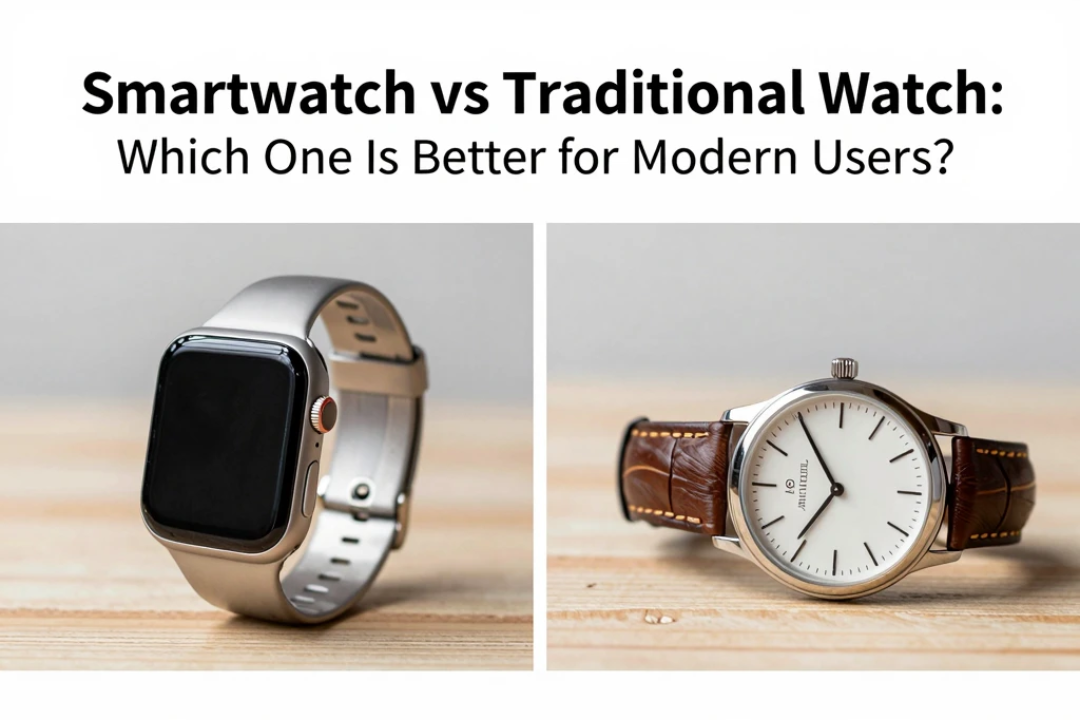
Watches have always been more than simple timekeeping devices. For decades, traditional watches have been associated with style, craftsmanship, reliability, and personal expression. Today, however, smartwatches are changing the way people think about what a watch can do.
A modern smartwatch can track fitness, monitor health-related metrics, display notifications, support calls, provide GPS navigation, control music, and perform many tasks that were impossible for traditional watches.
But does that automatically make a smartwatch better?
Not necessarily.
The choice between a smartwatch vs traditional watch depends on your lifestyle, priorities, budget, and the type of experience you want from a watch. Some users prefer technology and convenience, while others value simplicity, durability, craftsmanship, and timeless design.
In this guide, we’ll compare smartwatches and traditional watches across important categories to help you decide which option is better for modern users.
What Is a Smartwatch?
A smartwatch is a wearable electronic device that combines the basic function of a watch with digital technology.
Modern smartwatches can connect to smartphones and, in some cases, mobile networks. Depending on the model, they can provide features such as:
- Fitness tracking
- Heart-rate monitoring
- Sleep tracking
- GPS navigation
- Notifications
- Calls and messages
- Music controls
- Contactless payments
- Weather information
- Apps
- Voice assistants
- Customizable watch faces
Some smartwatches are designed primarily for fitness, while others focus on communication, productivity, health tracking, or lifestyle features.
What Is a Traditional Watch?
A traditional watch is primarily designed to tell time without relying on smartphone connectivity, apps, or electronic health sensors.
Traditional watches generally fall into two major categories: mechanical and quartz.
Mechanical watches use intricate movements powered by a spring, while quartz watches typically use a battery and electronic movement to keep time.
Traditional watches can range from inexpensive everyday models to luxury timepieces featuring high-quality materials and detailed craftsmanship.
For many people, a traditional watch is not simply a tool. It can be a fashion accessory, a personal statement, or even a long-term investment.
Smartwatch vs Traditional Watch: Key Differences
The biggest difference is straightforward.
A traditional watch focuses primarily on timekeeping and style, while a smartwatch combines timekeeping with digital functionality and connectivity.
Let’s compare them across several important categories.
1. Functionality
Smartwatches clearly have an advantage when it comes to functionality.
A modern smartwatch can do much more than tell the time. You can receive notifications, track workouts, check weather information, control music, monitor activity, and perform other tasks directly from your wrist.
Traditional watches are intentionally simpler.
They generally provide timekeeping and may include features such as a stopwatch, date display, chronograph, or other mechanical complications.
If you want a watch that acts as a mini extension of your smartphone, a smartwatch is the obvious choice.
If you want something simple that tells time without distractions, a traditional watch may be better.
2. Fitness and Health Tracking
This is one of the biggest advantages of smartwatches.
Many modern smartwatches include sensors capable of tracking various wellness and fitness metrics.
Depending on the device, these can include:
- Heart rate
- Steps
- Calories
- Distance
- Workout duration
- Sleep patterns
- Blood oxygen measurements
- Stress-related metrics
- Activity levels
Traditional watches generally don’t offer these capabilities.
For runners, cyclists, gym users, and people interested in monitoring daily activity, smartwatches can provide significantly more useful information.
However, smartwatch health measurements should generally be viewed as wellness information rather than a replacement for professional medical equipment.
3. Battery Life
Traditional watches usually win this category.
A quartz traditional watch can often operate for a long period before its battery needs replacement. Mechanical watches can operate without electronic batteries, although they require winding or movement and periodic servicing.
Smartwatches, on the other hand, need regular charging.
Depending on the model and usage, a smartwatch may need to be charged daily or every few days. Features such as GPS, cellular connectivity, health sensors, and always-on displays can increase power consumption.
If you dislike charging devices, a traditional watch may be significantly more convenient.
4. Durability
Durability depends heavily on the specific watch.
Traditional watches can be remarkably durable, particularly well-built models designed for outdoor or professional use.
Smartwatches can also be durable, with many models offering water resistance, reinforced materials, and scratch-resistant displays.
However, smartwatches contain electronic components, displays, batteries, and sensors. These components can make repairs more complicated than replacing a strap or servicing a traditional watch.
If you want something that can remain functional for many years with straightforward maintenance, a traditional watch has an advantage.
5. Style and Appearance
This category is highly subjective.
Smartwatches offer customization. You can change digital watch faces, straps, colors, and layouts to match different situations.
A smartwatch can look sporty during a workout and more formal with a different strap and watch face.
Traditional watches offer a different type of appeal.
Mechanical watches, especially, can showcase detailed craftsmanship, materials, and design. Some users appreciate the movement, dial, hands, and physical construction of a traditional timepiece.
For fashion-conscious users, the better choice depends on personal taste.
6. Notifications and Communication
Smartwatches have a major advantage in communication.
You can receive notifications for calls, messages, emails, calendar events, and applications.
Depending on the model, you may also be able to answer calls or respond to messages.
Some cellular smartwatches can connect to mobile networks independently of a smartphone for certain functions.
Traditional watches cannot compete in this area because they are not designed for digital communication.
If staying connected is important, a smartwatch is the clear winner.
7. Distractions and Digital Wellness
Interestingly, traditional watches have an advantage when it comes to avoiding digital distractions.
A traditional watch simply tells you the time.
A smartwatch may display messages, social media notifications, emails, reminders, and other alerts throughout the day.
For some people, this is extremely useful.
For others, it can become another source of digital distraction.
If your goal is to reduce screen time and spend less time checking notifications, a traditional watch may actually be the better choice.
8. Privacy
Privacy is another factor modern users should consider.
Smartwatches can collect information about activities, workouts, location, sleep, and other aspects of daily life.
The exact data collected and how it is handled depends on the manufacturer, software, settings, and connected services.
A traditional watch doesn’t generally collect this type of personal digital information.
For users who prioritize minimal digital data collection, a traditional watch offers a much simpler experience.
9. Cost and Long-Term Value
Smartwatch prices vary considerably.
There are affordable models designed for basic notifications and fitness tracking, as well as premium devices with advanced sensors, cellular connectivity, and high-end materials.
However, technology also becomes outdated.
A smartwatch may receive software updates for several years, but eventually its hardware, battery, or software compatibility may become limiting factors.
Traditional watches can have a very different lifespan.
A well-maintained mechanical or high-quality quartz watch can potentially remain useful for many years.
Some traditional watches are also passed between generations, giving them sentimental value beyond their original price.
10. Ease of Use
Traditional watches are extremely simple.
Put one on your wrist, set the time, and use it.
Smartwatches require more setup. You may need to pair them with a smartphone, configure notifications, install apps, customize settings, and occasionally troubleshoot connectivity or software issues.
For technology enthusiasts, this isn’t necessarily a disadvantage.
But if you want something that works without configuration, a traditional watch is hard to beat.
Smartwatch vs Traditional Watch: Comparison Table
| Feature | Smartwatch | Traditional Watch |
|---|---|---|
| Timekeeping | Yes | Yes |
| Fitness tracking | Excellent | Limited/None |
| Health sensors | Available on many models | Generally unavailable |
| GPS | Available | Usually unavailable |
| Notifications | Yes | No |
| Calls/messages | Some models | No |
| Apps | Yes | No |
| Battery charging | Required | Usually not required |
| Digital distractions | Higher | Very low |
| Customization | High | Moderate |
| Craftsmanship | Varies | Often a major focus |
| Long-term simplicity | Moderate | Excellent |
| Privacy | More data involved | Minimal digital data |
| Outdoor fitness | Excellent | Depends on model |
Who Should Buy a Smartwatch?
A smartwatch may be the better choice if you:
- Exercise regularly
- Want fitness tracking
- Need smartphone notifications
- Want GPS on your wrist
- Frequently receive calls or messages
- Like technology and customization
- Want health and wellness insights
- Prefer having multiple functions in one device
For active and technology-focused users, a smartwatch can be extremely useful.
Who Should Buy a Traditional Watch?
A traditional watch may be better if you:
- Prefer simplicity
- Don’t want to charge your watch
- Want a classic appearance
- Value mechanical craftsmanship
- Want fewer digital distractions
- Prefer minimal data collection
- Want a watch that can potentially last for many years
- Enjoy collecting traditional timepieces
For many people, a traditional watch remains the more elegant and straightforward option.
Can You Own Both?
Absolutely.
In fact, many watch enthusiasts own both smartwatches and traditional watches.
A smartwatch can be useful for workouts, travel, workdays, and situations where notifications and health tracking are valuable.
A traditional watch can be worn for formal occasions, social events, or simply when you want a more classic experience.
There is no rule saying you have to choose only one.
Which Is Better for Modern Users?
There isn’t a universal winner in the smartwatch vs traditional watch debate.
Smartwatches are better for users who want connectivity, fitness tracking, health insights, GPS, notifications, and digital convenience.
Traditional watches are better for people who value simplicity, craftsmanship, long-term durability, style, and freedom from charging and notifications.
Your lifestyle should ultimately determine your choice.
If you’re constantly active and want technology available on your wrist, a smartwatch makes sense. If you simply want a reliable and stylish timepiece without digital distractions, a traditional watch may be the better option.
Frequently Asked Questions
Are smartwatches better than traditional watches?
Smartwatches are better in terms of features and connectivity, while traditional watches often provide better simplicity, battery independence, and classic design. The better option depends on your priorities.
Do traditional watches last longer than smartwatches?
A quality traditional watch can potentially remain functional for many years with proper maintenance. Smartwatches have batteries and electronic components that can eventually require replacement or become outdated.
Are smartwatches good for fitness?
Yes. Fitness tracking is one of the strongest reasons to buy a smartwatch. Many models can track workouts, heart rate, steps, distance, calories, and other metrics.
Do smartwatches require a phone?
Many smartwatches work best when paired with a smartphone. Some cellular models can perform certain functions independently, but compatibility and available features vary.
Which watch is better for everyday use?
For users who want notifications, fitness tracking, and digital convenience, a smartwatch can be better. For users who prefer simplicity and traditional style, a traditional watch may be more suitable.
Final Verdict
The debate between a smartwatch and a traditional watch isn’t really about which technology is superior. It is about what you expect from your watch.
Smartwatches have transformed the wristwatch into a multifunctional device capable of tracking fitness, providing notifications, supporting communication, and offering useful everyday tools.
Traditional watches continue to succeed because they don’t try to do everything. They focus on timekeeping, design, craftsmanship, and simplicity.
For modern users, the best choice depends on lifestyle. If technology, fitness, and connectivity are priorities, choose a smartwatch. If timeless design, simplicity, and long-term use matter more, a traditional watch could be the perfect choice.
And if you love both, there is nothing wrong with having one of each.