





Smartphones have become one of the most important pieces of technology in modern life. We use them to communicate, work, study, take photos, watch videos, manage finances, navigate unfamiliar places, and stay connected with the world.
But smartphone technology is entering another major stage of development.
Instead of focusing only on faster processors and better cameras, manufacturers are exploring new designs, artificial intelligence, flexible displays, advanced connectivity, longer battery life, and smarter software experiences.
The future of smartphones is likely to be defined by devices that are more intelligent, flexible, personalized, and capable of handling tasks that previously required multiple devices.
Among the most important technologies shaping this future are foldable screens, artificial intelligence, advanced mobile processors, improved batteries, satellite connectivity, and next-generation cameras.
Let’s explore how these technologies could change smartphones in the coming years.
The Smartphone Is Becoming More Than a Phone
The traditional idea of a smartphone is already changing.
A modern smartphone is a camera, entertainment device, navigation system, communication tool, productivity computer, digital wallet, and personal assistant all in one.
As hardware becomes more powerful, software is also becoming more intelligent.
The next generation of smartphones will likely focus less on simply adding features and more on making those features work together.
For users, this could mean a smartphone that understands their habits, anticipates certain needs, and makes everyday tasks easier.
1. Foldable Smartphones Are Changing Phone Design
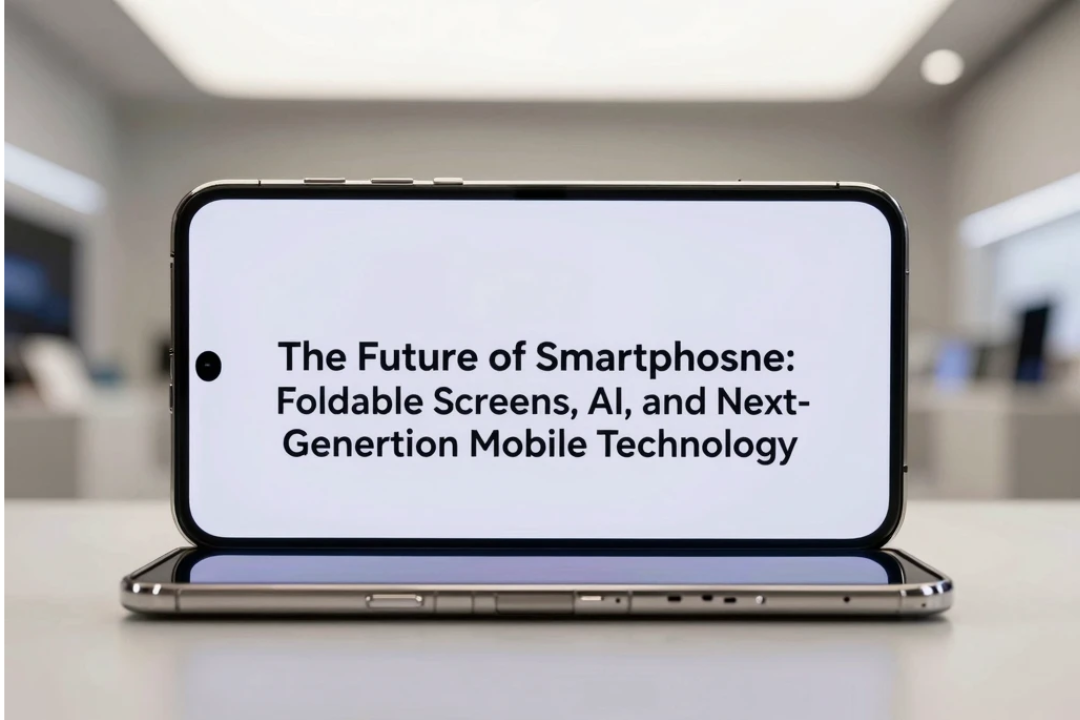
One of the most visible developments in smartphone design is the foldable phone.
Traditional smartphones have a fixed rectangular display. Foldable devices use flexible display technology to create new form factors.
There are several approaches to foldable designs.
Book-Style Foldables
These devices open like a small book. When closed, they work as a conventional smartphone. When opened, they provide a much larger screen that can be useful for multitasking, reading, video, and productivity.
Flip-Style Foldables
Flip phones use a compact design that folds vertically.
When closed, they become significantly smaller, making them easier to carry. When opened, users get a full-sized smartphone display.
Expanding and Flexible Displays
The industry is also exploring display concepts that can expand or change shape.
While not every experimental design will become a mainstream product, these technologies demonstrate that the traditional smartphone shape isn’t necessarily permanent.
Why Foldable Phones Matter
Foldable smartphones aren’t just about looking futuristic.
A larger screen can make certain tasks more comfortable.
Users may be able to:
- Run multiple apps simultaneously
- Read documents more comfortably
- Watch videos on a larger display
- Use productivity applications
- Edit photos and videos
- Browse websites with more screen space
The challenge is making foldable devices thin, durable, affordable, and reliable enough for everyday use.
As the technology matures, these limitations may continue to improve.
2. AI Will Become the Core of Future Smartphones
Artificial intelligence is arguably one of the most important technologies shaping the future of mobile devices.
Today’s smartphones already use AI for camera processing, voice recognition, translation, writing assistance, battery management, and photo editing.
Future AI systems are likely to become much more integrated into the operating system.
Instead of simply opening an application and completing a task manually, users may be able to describe what they want and allow AI to assist with multiple steps.
For example, a user could ask an AI assistant to summarize information, create a message, organize a schedule, or find specific content across supported applications.
This could make smartphones feel more like intelligent personal assistants.
3. On-Device AI Will Become More Powerful
Cloud-based AI services require an internet connection for many advanced tasks.
However, smartphone manufacturers are increasingly adding specialized hardware designed to process AI workloads directly on the device.
On-device AI can provide several advantages:
- Faster responses
- Better privacy for supported tasks
- Reduced dependence on the internet
- Lower cloud-processing requirements
- More personalized experiences
Future smartphone processors are likely to include increasingly powerful neural processing capabilities.
This could allow smartphones to perform more advanced AI tasks without sending every request to a remote server.
4. Smartphone Cameras Will Become More Intelligent
Camera improvements will continue to be an important part of smartphone development.
However, the future isn’t only about increasing megapixel counts.
AI and computational photography are likely to become even more important.
Future smartphones may automatically analyze scenes and adjust image processing based on the subject, lighting, movement, and environment.
AI could also improve:
- Night photography
- Portraits
- Video stabilization
- Zoom processing
- Object removal
- Image enhancement
- Automatic editing
- Low-light video
The goal is to make professional-looking photography easier for ordinary users.
5. Smartphone Battery Technology Will Continue to Improve
Battery life remains one of the biggest concerns for smartphone users.
Powerful processors, high-refresh-rate displays, 5G connectivity, gaming, and AI features can all increase energy consumption.
Manufacturers therefore have strong reasons to improve battery technology.
Future smartphones may benefit from advances in battery chemistry, charging technology, energy management, and processor efficiency.
AI can also help manage power consumption by learning user behavior and optimizing background activity.
Faster charging is likely to remain important as well, although manufacturers will need to balance charging speed with heat management and long-term battery health.
6. Better Displays With More Flexible Designs
Smartphone displays are becoming brighter, smoother, more efficient, and more adaptable.
High-refresh-rate screens have already improved scrolling and gaming experiences.
Future displays could offer even better energy efficiency while supporting flexible or unusual form factors.
We may also see improvements in:
- Brightness
- Outdoor visibility
- Color accuracy
- Refresh rates
- Touch response
- Durability
- Power efficiency
For foldable devices, stronger flexible displays will be particularly important.
7. Next-Generation Mobile Connectivity
Mobile connectivity is also evolving.
5G has already transformed smartphone networking by providing faster speeds and lower latency in supported areas.
Future connectivity technologies could further improve mobile performance.
The development of next-generation networks may eventually support faster communication, more reliable connections, and improved performance for cloud gaming, augmented reality, connected devices, and other demanding applications.
Smartphones may also increasingly support satellite-based connectivity for specific communication scenarios where traditional cellular networks are unavailable.
This could be particularly valuable for travelers, hikers, emergency situations, and people living in remote areas.
8. Smartphones Could Become More Connected to Other Devices
The future smartphone is unlikely to operate as an isolated device.
Instead, it will increasingly act as a central hub for a connected ecosystem.
A smartphone can already interact with:
- Smartwatches
- Wireless earbuds
- Smart TVs
- Cars
- Smart home devices
- Laptops
- Tablets
- Fitness trackers
Future ecosystems may make these connections more seamless.
For example, a smartphone could automatically transfer tasks between devices or allow users to control multiple products from a single interface.
This could make technology feel less fragmented.
9. Security Will Become More Intelligent
As smartphones store more personal and financial information, security will become increasingly important.
Future devices are likely to combine biometric authentication, hardware security, AI-based threat detection, encryption, and intelligent privacy controls.
AI could potentially help identify suspicious behavior or unusual activity.
However, smarter technology also creates new privacy questions.
Users will need greater transparency about how personal data is collected, processed, and stored.
10. Smartphones May Become More Personalized
Future smartphones could become significantly better at understanding individual users.
AI may learn preferences related to:
- Frequently used applications
- Communication habits
- Daily schedules
- Travel routines
- Content preferences
- Notification patterns
- Battery usage
The goal would be a device that adapts to its owner rather than forcing every user to interact with it in exactly the same way.
Personalization could make smartphones more convenient while reducing the amount of manual configuration required.
11. Smartphone Software Will Become More AI-Driven
The operating system itself is likely to become more intelligent.
Instead of AI being limited to individual applications, it may become a fundamental layer of the smartphone experience.
AI could assist with tasks such as:
- Summarizing notifications
- Organizing photos
- Managing schedules
- Writing messages
- Translating conversations
- Searching files
- Creating reminders
- Adjusting settings
This could reduce the need to navigate through multiple menus and applications.
12. Augmented Reality Could Become More Important
Augmented reality, or AR, has been discussed for years, but smartphones still have significant potential in this area.
Future devices could use improved cameras, sensors, processors, and AI to make AR applications more useful.
Possible applications include:
- Navigation overlays
- Furniture visualization
- Educational experiences
- Shopping previews
- Real-time translation
- Gaming
- Virtual product demonstrations
As smartphone hardware improves, AR could become more integrated into everyday applications.
13. Smartphone Materials May Become More Durable
Consumers expect smartphones to survive years of daily use.
Future devices may use stronger glass, improved frames, more advanced hinges for foldables, and better water and dust resistance.
Durability is especially important for foldable smartphones because their moving components introduce additional engineering challenges.
Manufacturers will need to make flexible devices durable enough for everyday use while keeping them thin and lightweight.
14. Will Smartphones Eventually Replace Computers?
Smartphones are already capable of performing many tasks traditionally associated with computers.
With powerful processors, external displays, wireless accessories, and desktop-style software, a smartphone can sometimes act as a portable computer.
Future smartphones may become even more capable.
A single device could potentially power a larger display, connect to a keyboard and mouse, and provide a desktop-like experience when needed.
However, dedicated computers will likely remain important for demanding professional workloads, specialized software, gaming, and tasks requiring large screens.
Challenges Facing Future Smartphones
The future of smartphones isn’t without challenges.
Manufacturers must balance advanced technology with:
- Cost
- Battery life
- Heat
- Durability
- Privacy
- Repairability
- Software support
- Environmental impact
Adding more features isn’t always the best solution.
Consumers increasingly want devices that are reliable and useful rather than simply packed with specifications.
What Will the Smartphone of the Future Look Like?
The smartphone of the future may look very different from today’s traditional rectangular device.
It could be foldable, rollable, or otherwise flexible. AI could become a central part of the user experience, while improved batteries and processors could provide longer-lasting performance.
Cameras may become increasingly intelligent, connectivity may become more seamless, and smartphones could work as hubs for entire digital ecosystems.
Most importantly, the device may become more proactive.
Instead of waiting for users to manually open applications and perform tasks, future smartphones could understand context and provide assistance when needed.
Frequently Asked Questions
What is the future of smartphones?
The future of smartphones is likely to focus on AI, foldable displays, better cameras, improved battery technology, advanced connectivity, personalization, and stronger integration with other devices.
Are foldable phones the future?
Foldable phones are an important direction for smartphone design, but they are not guaranteed to completely replace traditional phones. Their long-term success will depend on durability, price, software support, and consumer demand.
How will AI change smartphones?
AI can make smartphones better at photography, voice assistance, translation, search, productivity, security, battery management, and personalization.
Will smartphones replace laptops?
Smartphones may handle more computer-like tasks in the future, but laptops will likely remain valuable for professional software, large-screen productivity, advanced gaming, and demanding workloads.
Will future smartphones have better battery life?
Battery technology and processor efficiency are expected to improve. AI-powered power management can also help devices use energy more efficiently.
Final Thoughts
The future of smartphones is about much more than faster processors or higher-resolution cameras.
Foldable displays, artificial intelligence, improved batteries, advanced connectivity, smarter cameras, and connected ecosystems are changing what a smartphone can be.
The most important shift may be the move from smartphones as simple tools to smartphones as intelligent assistants.
As these technologies mature, the devices we carry every day could become more adaptable, more personalized, and more capable than ever before.
The smartphone may still fit in our pocket, but its role in our digital lives is likely to become much bigger.