





Photography has never been more accessible than it is today. A few years ago, taking high-quality photographs often meant carrying a dedicated digital camera, learning manual settings, and spending time transferring and editing photos.
Today, most people already carry a powerful camera in their pocket.
Modern smartphones can capture detailed photos, record high-resolution video, process images with artificial intelligence, and instantly share the results online. For everyday photography, this convenience has made smartphones increasingly attractive compared with traditional dedicated cameras.
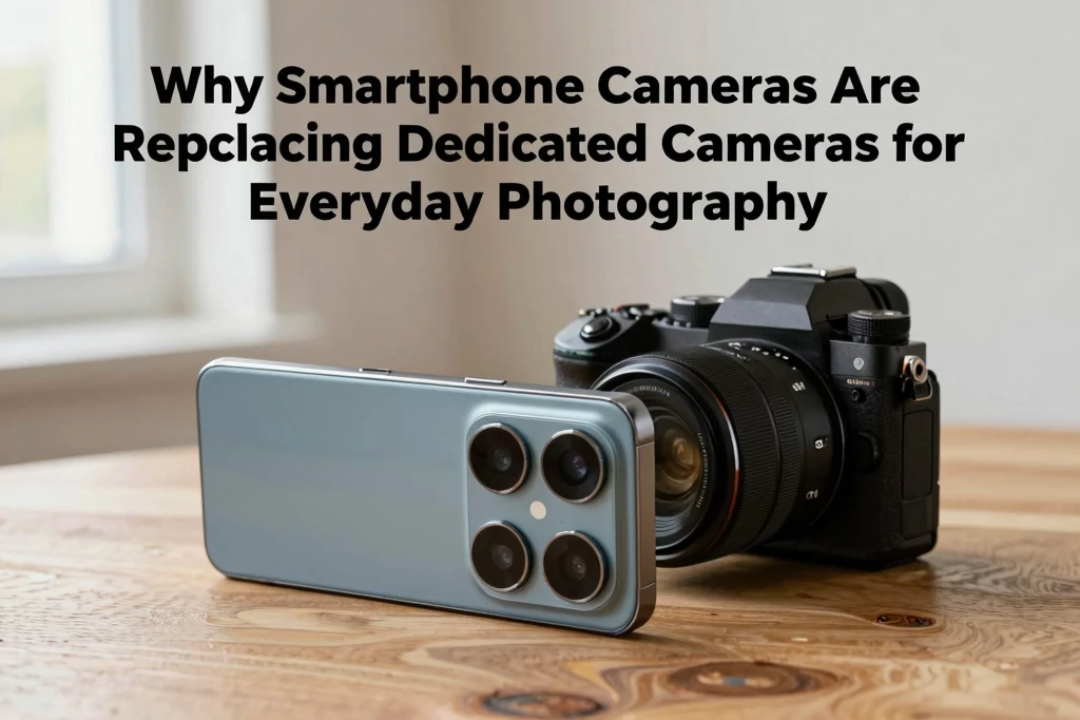
This does not mean dedicated cameras are becoming useless. Professional photographers, enthusiasts, and people who need advanced optical capabilities still have strong reasons to use mirrorless or DSLR cameras. However, for casual photography, travel, family moments, social media, and everyday memories, smartphones are becoming the first choice for many users.
So, why are smartphone cameras replacing dedicated cameras for everyday photography? Let’s take a closer look.
Smartphones Are Always With You
The biggest advantage of a smartphone camera is simple: it is already in your pocket.
A dedicated camera is another device that needs to be carried, charged, and remembered. A smartphone, on the other hand, is something most people already take with them everywhere.
This makes it much easier to capture spontaneous moments.
Whether you’re having dinner with friends, visiting a new place, watching a family event, or simply seeing an interesting scene on the street, your smartphone is usually ready to take a picture within seconds.
Photography is often about capturing the right moment. Convenience can therefore be just as important as image quality.
Modern Smartphone Cameras Offer Impressive Image Quality
Smartphone camera hardware has improved significantly.
Many modern phones feature multiple cameras, including:
- Main wide-angle cameras
- Ultra-wide cameras
- Telephoto cameras
- Macro cameras
- Depth-sensing systems on some devices
These cameras give users more flexibility without requiring them to carry multiple lenses.
Smartphone manufacturers have also invested heavily in larger image sensors, improved lenses, optical image stabilization, and advanced image-processing systems.
As a result, photos captured on modern smartphones can look remarkably good, particularly in good lighting.
Computational Photography Is Changing the Game
One of the biggest reasons smartphone cameras have become so capable is computational photography.
Traditional cameras mainly depend on the lens and sensor to capture an image. Smartphones combine their camera hardware with sophisticated software that can process the image immediately.
A phone can analyze multiple frames and combine information from them to create a final photograph.
This can help improve:
- Dynamic range
- Exposure
- Noise reduction
- Sharpness
- Color balance
- Shadow detail
- Highlight control
- Portrait effects
Instead of asking users to manually adjust settings, the smartphone performs much of the work automatically.
For everyday photography, this simplicity is extremely valuable.
AI Is Making Smartphone Photography Smarter
Artificial intelligence is playing an increasingly important role in smartphone photography.
AI-powered camera systems can recognize scenes, faces, objects, lighting conditions, and other elements within an image.
The phone can then adjust processing based on what it sees.
For example, a smartphone may recognize a night scene and automatically apply enhanced low-light processing. It may identify a portrait and adjust skin tones and background separation.
AI can also help with editing after the photo has been taken.
Some modern phones offer tools for:
- Removing unwanted objects
- Improving image clarity
- Adjusting lighting
- Reframing images
- Enhancing portraits
- Improving low-light photos
- Creating background effects
This makes photography accessible even to users who have little or no editing experience.
Night Photography Has Improved Dramatically
Low-light photography was once one of the biggest weaknesses of smartphone cameras.
That has changed significantly.
Modern smartphones can use larger sensors, optical stabilization, multi-frame processing, and computational photography to capture brighter and more detailed photos in challenging lighting.
Night modes can automatically capture several frames and combine them into a final image.
The process usually happens automatically, so users don’t need a tripod or detailed knowledge of exposure settings for many everyday situations.
Dedicated cameras can still provide excellent low-light results, particularly when paired with large sensors and fast lenses. However, smartphones have made good night photography much easier for ordinary users.
Smartphones Make Portrait Photography Simple
Dedicated cameras traditionally required specific lenses and settings to achieve strong background blur.
Smartphones have made portrait photography much simpler.
Using multiple cameras, depth information, and software processing, smartphones can separate the subject from the background and create a simulated shallow-depth-of-field effect.
Users can often adjust the intensity of the blur after taking the photo.
This is particularly popular for:
- Family portraits
- Selfies
- Social media photos
- Food photography
- Product photos
- Casual portraits
While software-generated blur isn’t identical to the optical characteristics of a large camera sensor and professional lens, it can produce attractive results for everyday use.
Smartphones Are Better for Social Media
Another major reason smartphone cameras are replacing dedicated cameras for casual photography is the way people share photos.
A smartphone can capture an image and immediately send it to:
- TikTok
- Snapchat
- Cloud storage
There is no need to remove a memory card, connect a cable, transfer files to a computer, resize images, and then upload them.
The entire process can happen on one device.
For people who primarily take photographs for social media or messaging, this convenience is difficult to beat.
Smartphone Editing Is Built In
Modern phones don’t just take photos. They also provide powerful editing tools.
Users can crop, rotate, adjust brightness, change contrast, apply filters, remove objects, improve portraits, and perform other edits directly on the device.
AI-powered editing tools can make the process even easier.
This means the complete photography workflow—from capturing an image to editing and sharing it—can happen on the same device.
For everyday users, that can be more valuable than having a camera capable of capturing technically superior raw files.
Smartphone Video Has Become Extremely Capable
Smartphones are also becoming popular for video.
Many modern devices offer advanced video stabilization, high-resolution recording, slow motion, time-lapse, portrait video effects, and other creative tools.
This makes smartphones useful for:
- Travel videos
- Family events
- Social media content
- Short-form videos
- Vlogs
- Product demonstrations
- Everyday memories
The ability to quickly record, edit, and upload video from one device is a major advantage.
Portability Makes a Huge Difference
Dedicated cameras can be relatively small, but once you add lenses, batteries, memory cards, and other accessories, the equipment can become much more difficult to carry.
A smartphone eliminates much of that extra equipment.
For a casual photographer, carrying one lightweight device instead of a camera bag can make photography more enjoyable.
This is particularly useful during:
- Travel
- Hiking
- City walks
- Family trips
- Events
- Vacations
The best camera is often the one you actually have with you.
Smartphone Cameras Are Easier to Use
Dedicated cameras offer enormous control, but that control can also make them complicated.
Users may need to understand:
- Aperture
- Shutter speed
- ISO
- Focusing modes
- White balance
- Exposure compensation
- Lens selection
Smartphones automate many of these decisions.
A user can simply point the phone at a subject, tap the screen, and take a photo.
For everyday photography, this simplicity can be more useful than having complete manual control.
Storage and Cloud Backup Add Convenience
Smartphones can automatically back up photos to cloud storage, depending on the services and settings being used.
This reduces the risk of losing important memories if the phone is damaged or lost.
Dedicated cameras can also use cloud-connected workflows, but smartphones generally make the process much simpler for ordinary users.
Photos can also be organized automatically by date, location, people, and other information on supported platforms.
This makes finding older photographs much easier.
Smartphones Are Becoming Better at Zoom
Zoom has traditionally been an area where dedicated cameras had a major advantage.
Interchangeable lenses can provide enormous optical reach.
However, smartphone manufacturers have improved mobile zoom through telephoto lenses, image stabilization, computational photography, and advanced image processing.
Some premium smartphones now provide useful optical or hybrid zoom capabilities that are more than enough for everyday photography.
For casual travel photos, portraits, and distant subjects, smartphone zoom has become increasingly practical.
Still, dedicated cameras remain far ahead when serious long-range photography is required.
Why Dedicated Cameras Still Matter
Despite all these advantages, smartphones haven’t completely replaced dedicated cameras.
Professional and enthusiast photographers still benefit from larger sensors, interchangeable lenses, advanced autofocus systems, greater manual control, and better performance in demanding situations.
Dedicated cameras are particularly valuable for:
- Professional photography
- Wildlife photography
- Sports photography
- Studio photography
- Commercial work
- High-end portrait photography
- Long-distance telephoto photography
A professional camera also provides greater flexibility for photographers who want complete creative control.
Therefore, the smartphone isn’t necessarily replacing the dedicated camera everywhere. It is mainly replacing it for everyday photography.
Smartphone vs Dedicated Camera for Everyday Photography
| Feature | Smartphone | Dedicated Camera |
|---|---|---|
| Portability | Excellent | Good to moderate |
| Ease of use | Excellent | Requires learning |
| Sharing | Instant | Usually requires transfer |
| Editing | Built in | Often requires additional software |
| AI features | Extensive | Varies |
| Lens flexibility | Limited | Excellent |
| Manual control | Moderate | Excellent |
| Professional quality | Very good | Excellent |
| Everyday convenience | Excellent | Moderate |
| Video sharing | Extremely easy | More involved |
For everyday users, the smartphone wins in convenience and simplicity. For professionals, dedicated cameras continue to offer advantages that smartphones cannot completely replicate.
Who Should Choose a Smartphone Camera?
A smartphone camera is likely enough if you mainly photograph:
- Family moments
- Food
- Travel
- Pets
- Social media content
- Casual portraits
- Everyday events
- Short videos
It is especially useful if you want to take a picture, edit it, and share it within minutes.
Who Should Still Buy a Dedicated Camera?
A dedicated camera makes more sense if photography is a serious hobby or profession.
You may benefit from one if you need interchangeable lenses, advanced manual controls, professional RAW workflows, high-quality telephoto performance, or maximum image quality in challenging conditions.
The important thing is to choose equipment based on your actual needs rather than simply buying the most expensive option.
The Future of Smartphone Photography
Smartphone photography is likely to become even more intelligent.
AI could improve image processing, editing, object recognition, video stabilization, and automatic composition.
Camera hardware will also continue to evolve, while smartphone processors become more capable of handling complex computational photography tasks.
The future may involve smartphones automatically understanding the scene and selecting the best capture settings before the user even thinks about them.
As these technologies improve, the gap between smartphone photography and traditional cameras may continue to shrink for everyday users.
Frequently Asked Questions
Are smartphone cameras better than digital cameras?
For everyday photography, smartphones can be more convenient and easier to use. Dedicated cameras still generally offer greater flexibility, lens options, and professional-level control.
Why are smartphone cameras so good now?
Better sensors, lenses, image stabilization, powerful processors, computational photography, and AI-powered image processing have significantly improved smartphone photography.
Can a smartphone replace a professional camera?
For casual photography and some types of content creation, yes. However, professional photographers may still require the larger sensors, interchangeable lenses, and advanced controls offered by dedicated cameras.
Is smartphone photography good enough for travel?
For most travelers, modern smartphone cameras are more than capable of capturing high-quality photos and videos while offering excellent portability and instant sharing.
Will smartphones completely replace cameras?
Probably not. Smartphones are increasingly replacing dedicated cameras for everyday photography, but professional and enthusiast photographers will continue to benefit from dedicated camera systems.
Final Thoughts
Smartphone cameras have become powerful enough that many people no longer feel the need to carry a separate camera for everyday photography.
Their biggest advantage isn’t just image quality. It is the combination of camera hardware, AI, computational photography, editing tools, portability, connectivity, and instant sharing in one device.
Dedicated cameras still have an important place in professional and enthusiast photography, but for capturing everyday moments, smartphones offer an incredibly convenient solution.
The future of photography is unlikely to be about one device completely replacing another. Instead, smartphones will continue handling more everyday photography while dedicated cameras remain important for people who need maximum creative control and specialized performance.