




Choosing a smartwatch can be surprisingly difficult. There are hundreds of models available, ranging from affordable fitness-focused devices to premium smartwatches packed with advanced health sensors, GPS, cellular connectivity, and smart features.
The problem is that the most expensive smartwatch isn’t necessarily the best smartwatch for you.
The right choice depends on how you plan to use it, which smartphone you own, the features you actually need, how often you want to charge it, and how much you are willing to spend.
Whether you want a smartwatch for fitness, health tracking, work, communication, or everyday convenience, this guide will help you understand how to choose the right smartwatch for your lifestyle and budget.
Why Choosing the Right Smartwatch Matters
A smartwatch is something you may wear for many hours every day. Unlike a smartphone, it stays directly on your wrist, so comfort, battery life, software, and usability matter considerably.
Buying the wrong model can mean dealing with poor battery life, missing features, compatibility problems, or paying for functions you never use.
Before looking at brands or specifications, start by identifying your priorities.
Ask yourself:
- Why do I want a smartwatch?
- Do I exercise regularly?
- Do I need health tracking?
- Do I want calls and messages on my wrist?
- Do I need GPS?
- How long should the battery last?
- What is my budget?
- Which smartphone do I use?
Once you answer these questions, choosing becomes much easier.
1. Decide How You Will Use Your Smartwatch
The first step is identifying your primary reason for buying one.
Different users need different features.
For Fitness
If you’re buying a smartwatch mainly for exercise, prioritize:
- Accurate workout tracking
- GPS
- Heart-rate monitoring
- Step tracking
- Workout modes
- Battery life
- Water resistance
- Comfortable design
Runners and cyclists should pay particular attention to GPS accuracy and battery performance during outdoor workouts.
For Everyday Use
If your main goal is convenience, you may care more about:
- Notifications
- Calls
- Messages
- Battery life
- Display quality
- Comfort
- Music controls
- Weather
- Calendar integration
You don’t necessarily need the most advanced fitness sensors.
For Health and Wellness
Users interested in health and wellness should look for relevant tracking features such as:
- Heart-rate monitoring
- Sleep tracking
- Activity tracking
- Blood oxygen measurements where available
- Stress-related metrics
- Temperature-related sensors where available
Remember that smartwatch health features generally provide wellness information and should not replace professional medical evaluation.
2. Check Smartphone Compatibility
One of the most important steps when buying a smartwatch is checking compatibility with your smartphone.
Not every smartwatch works equally well with every phone.
Some devices are designed around specific smartphone ecosystems, while others support a wider range of devices.
Compatibility can affect:
- Notifications
- Calls
- Messaging
- Health applications
- App installation
- Synchronization
- Voice assistants
- Software updates
Before purchasing, check the manufacturer’s official compatibility requirements.
A smartwatch may have impressive specifications, but if important features don’t work with your phone, the experience can be disappointing.
3. Choose the Right Smartwatch Size
Smartwatch size is often overlooked.
A large display can make notifications and fitness information easier to read, but a larger watch may feel uncomfortable on a smaller wrist.
Smaller watches can be lighter and more comfortable, particularly during sleep and exercise.
When comparing models, consider both case size and thickness.
If possible, try the watch on your wrist before buying it.
Remember that you may wear the device for most of the day, so comfort should be treated as a priority rather than an afterthought.
4. Consider Battery Life Carefully
Battery life is one of the most important smartwatch features.
Some models require frequent charging, while others can last several days depending on usage.
Think about how you intend to use your watch.
If you want to track sleep every night, a watch with short battery life may become inconvenient because you’ll need to remove it frequently for charging.
Features such as GPS, cellular connectivity, always-on displays, and continuous health monitoring can also reduce battery life.
Instead of relying only on the manufacturer’s maximum battery claim, look for information about expected real-world usage.
5. Decide Whether You Need GPS
GPS is extremely useful for outdoor activities.
If you regularly run, walk, hike, or cycle, built-in GPS can record your route, distance, and pace without requiring your phone to be with you.
For casual users who always carry a smartphone, GPS may not be essential.
Ask yourself whether you actually need independent location tracking.
If the answer is no, you may be able to save money by choosing a model without advanced GPS capabilities.
6. Look at Health and Fitness Sensors
Smartwatch sensors have become increasingly sophisticated.
Depending on the model, you may find sensors for heart-rate monitoring, blood oxygen measurements, temperature-related tracking, movement detection, and other wellness functions.
However, more sensors don’t automatically mean a better smartwatch.
The important question is whether those sensors are useful to you.
For example, a casual user may not need advanced athletic metrics, while a serious runner may consider them essential.
Choose features based on your lifestyle rather than simply choosing the longest specification list.
7. Consider Cellular Connectivity
Some smartwatches offer cellular connectivity, allowing them to connect to mobile networks for certain functions.
This can be useful if you want to leave your smartphone behind during workouts or short trips.
For example, you may be able to make calls, receive messages, or use certain online features directly from the watch.
However, cellular models are usually more expensive and may require an additional service plan.
If you always carry your smartphone, cellular connectivity may not be worth the extra cost.
8. Choose the Right Display
The display affects almost every interaction with a smartwatch.
Look for a screen that is bright enough for outdoor use and sharp enough to read text comfortably.
Display technology can affect contrast, colors, brightness, and battery consumption.
An always-on display is convenient because you can glance at the time without interacting with the watch.
However, it may consume additional power.
Consider whether convenience or maximum battery life is more important to you.
9. Don’t Ignore Durability and Water Resistance
If you plan to wear your smartwatch during workouts or outdoor activities, durability matters.
Look for a model with suitable protection against scratches, impacts, sweat, and water.
Water resistance is especially important for swimmers and people who exercise outdoors.
However, water resistance ratings have specific limitations.
Don’t assume that a watch rated for everyday splashes is automatically suitable for swimming or diving.
Always check the manufacturer’s guidelines.
10. Think About Software and Apps
Hardware specifications are only part of the smartwatch experience.
Software can determine how easy the device is to use and how many features are available.
Before buying, consider:
- Available apps
- Smartphone integration
- Software updates
- Watch-face selection
- Notification controls
- Health applications
- Music support
- Navigation
- Voice features
Long-term software support is particularly important.
A smartwatch may have excellent hardware, but limited software support can reduce its usefulness over time.
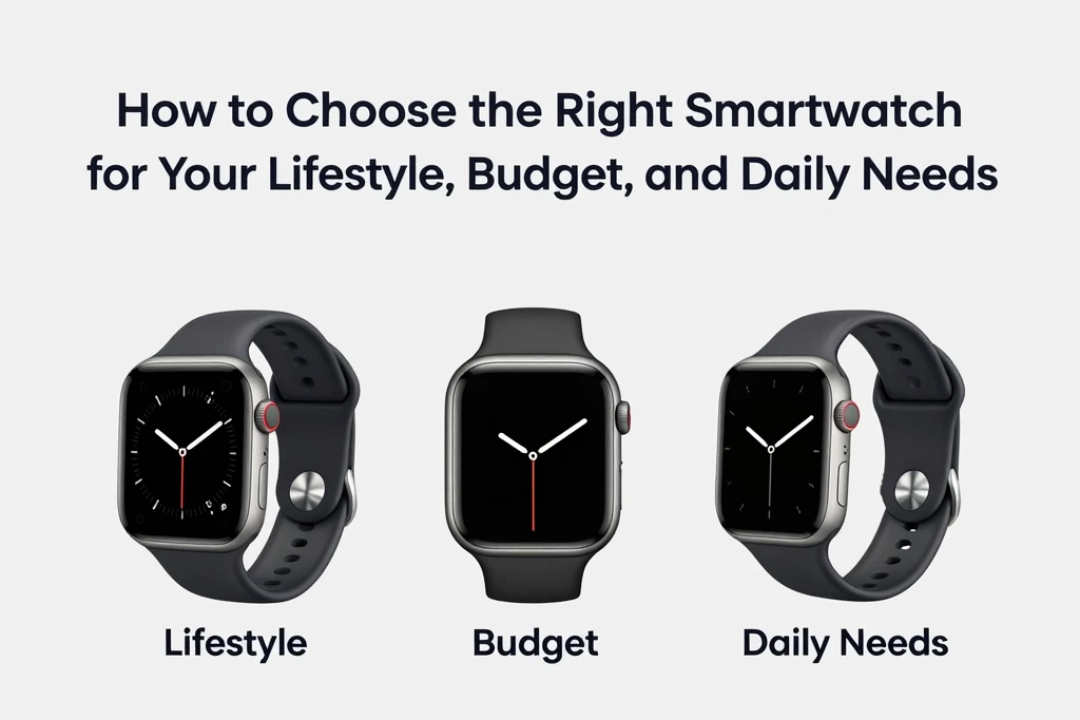
11. Set a Realistic Budget
Smartwatch prices can range from inexpensive entry-level devices to premium models costing considerably more.
A good strategy is to set a budget before comparing products.
Budget Smartwatches
Budget models can be suitable for users who mainly want:
- Step tracking
- Basic workouts
- Notifications
- Heart-rate monitoring
- Simple watch faces
- Basic sleep tracking
Mid-Range Smartwatches
Mid-range models often provide a better combination of:
- GPS
- Better displays
- Improved sensors
- More workout modes
- Better software
- Longer battery life
Premium Smartwatches
Premium models may offer:
- Advanced health features
- Cellular connectivity
- Premium materials
- Better processors
- More sophisticated fitness tools
- Enhanced displays
- More extensive software ecosystems
The key is to avoid paying for features you don’t need.
12. Think About Long-Term Value
Price isn’t the only thing that matters.
Consider how long you expect to use the smartwatch.
A slightly more expensive model may provide better value if it offers stronger battery performance, better software support, more durable construction, and features you’ll actually use.
Also consider the cost of replacement straps, accessories, cellular plans, and other extras.
A smartwatch is more than the initial purchase price.
13. Consider Comfort and Strap Options
Comfort is especially important because smartwatches are designed to be worn for long periods.
A watch that feels comfortable for five minutes in a store may feel different after eight hours.
Look for:
- Lightweight construction
- Comfortable straps
- Adjustable sizing
- Breathable materials
- A case size suitable for your wrist
Interchangeable straps are also useful because you can change the appearance and feel of the watch for different situations.
14. Don’t Buy Features You Won’t Use
One of the biggest smartwatch buying mistakes is paying for specifications rather than usefulness.
A premium smartwatch may offer dozens of features, but if you only use notifications, steps, and basic workouts, a cheaper model could provide a better overall value.
Before buying, make a list of your five most important features.
For example:
- Long battery life
- GPS
- Heart-rate tracking
- Notifications
- Comfortable design
Use this list to compare models.
Smartwatch Buying Guide by User Type
| User Type | Features to Prioritize |
|---|---|
| Casual user | Battery, notifications, comfort, display |
| Runner | GPS, heart rate, workout tracking, battery |
| Gym user | Workout modes, heart rate, comfort |
| Swimmer | Water resistance, swim tracking, durability |
| Outdoor user | GPS, durability, battery, safety features |
| Professional | Notifications, calls, calendar, battery |
| Health-focused user | Wellness tracking, sleep, heart rate |
| Budget buyer | Essential features, battery, compatibility |
Common Smartwatch Buying Mistakes
Avoid these mistakes when choosing your next smartwatch.
Ignoring Compatibility
Always confirm that the watch works with your smartphone.
Choosing Based Only on Price
The most expensive model isn’t automatically the best.
Forgetting Battery Life
Advanced features are not useful if you’re constantly charging the device.
Buying Too Large a Watch
A large screen isn’t worth sacrificing comfort.
Ignoring Software Support
Long-term updates can be just as important as hardware.
Paying for Unnecessary Features
Focus on the features you will actually use.
Frequently Asked Questions
How do I choose the right smartwatch?
Start by identifying your main purpose. Decide whether you need fitness tracking, health monitoring, notifications, GPS, calls, or simply basic smartwatch functions. Then compare compatibility, battery life, comfort, software, and price.
How much should I spend on a smartwatch?
There is no single correct budget. Casual users can often choose an affordable model, while fitness enthusiasts and users who need advanced features may benefit from spending more.
Is GPS important in a smartwatch?
GPS is particularly useful for runners, cyclists, hikers, and outdoor users. If you always carry your phone, you may not need advanced built-in GPS.
Should I buy a cellular smartwatch?
A cellular smartwatch can be useful if you want to make calls or use certain connected features without carrying your smartphone. Otherwise, Bluetooth-only models may provide better value.
How long should a smartwatch battery last?
Battery requirements depend on usage. If you track workouts and sleep regularly, longer battery life can make the device much more convenient.
Final Verdict
Learning how to choose the right smartwatch is ultimately about matching technology to your lifestyle.
Don’t start with the most expensive model or the longest list of specifications. Start with your daily needs.
If you’re a fitness enthusiast, prioritize GPS, workout tracking, heart-rate monitoring, battery life, and durability. If you’re a professional, notifications, calls, calendar features, and comfort may matter more. Casual users can focus on battery life, display quality, notifications, and price.
Most importantly, don’t pay for features you will never use.
The best smartwatch is the one that fits comfortably on your wrist, works reliably with your smartphone, lasts long enough for your routine, and provides features that genuinely make your everyday life easier.
By defining your priorities before shopping, you can avoid unnecessary spending and choose a smartwatch that offers real value for your money in 2026.